
Wednesday, June 15, 2016



Tuesday, June 14, 2016
Welcome, Olympic Tourists, to Brazil. Please Don’t Mind the Mess
- Instead of Brazil’s best, Olympics will showcase nation’s bust
- Tourists may face commute delays. Cuts for locals more severe.
When Rio de Janeiro won the rights in 2009 to host the Olympics, Brazil planned a blitz of projects to showcase just how far it had risen. But when tourists start showing up in two months to attend the games, it’ll be the bust and not Brazil’s best that’ll be on display.
That sewage-filled harbor that visitors will pass on the way from the airport -- and the spot where Olympic sailing events will be staged -- was supposed to be a shimmering, clean bay. That new metro line they’ll take from the posh Ipanema beach neighborhood to the games will at best run on a limited schedule, having started operations just four days before the opening ceremony. And what about the state-of-the-art gear that police were supposed to get to help keep travelers safe? A top official says it never happened.
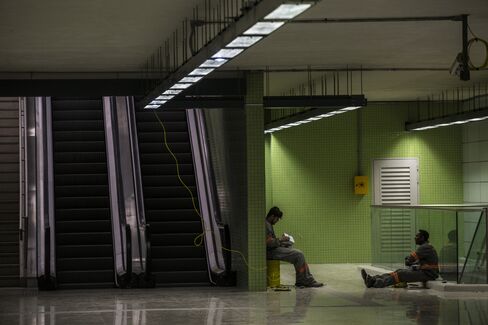
Workers sit beside escalators at the Nossa Senhora da Paz metro station in Rio de Janeiro.
Welcome to Brazil, a land of political, economic and fiscal crisis.
“When you look back at the bid documents from 2009, the Olympics were definitely designed and pitched as a way of showcasing Brazil as this thriving democracy and burgeoning economy,” said Jules Boykoff, the author of a book on Olympics history that’s critical about the legacy of major sporting events. “How big a difference seven years make.”
QuickTake: In Brazil, Hopes Give Way to Slump, Scandal, Turmoil
To be fair, most of the 39 billion reais ($11 billion) in arenas and infrastructure being built ahead of the Olympics will be ready in time and, besides a few eyesores and commuting delays, most tourists may not even notice all that should have been. But the unfinished work is an indication of a much bigger problem that will last long after the visitors jet out: Rio state is all but broke.
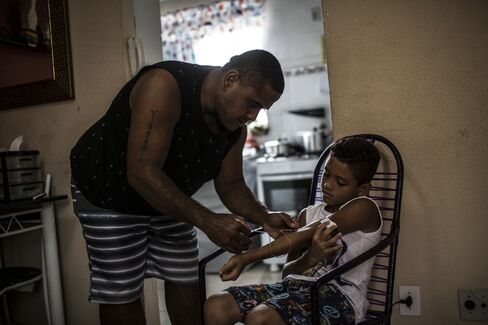
Rodrigo Batista da Silva administers state-issued medicine to his 9-year-old son.
No one knows that better than Joao Vitor da Silva and his father, Rodrigo da Silva. The scrawny nine-year-old in an Iron Man T-shirt is a hemophiliac, and Batista said they’ve been warned that public-health spending cuts may disrupt supplies of prophylaxis, the shots that prevent Joao from bleeding out whenever he’s injured or sick.
“If there’s money for the Olympics, there has to be money for health,” said Da Silva, a 34-year-old former forklift-operator who’s on medical leave.
Brazil’s hardly the first nation to host the Olympics games from a hotbed of chaos. (Russia, Mexico and South Korea are all part of the club.) Even so, the tumultuous backdrop when the games begin Aug. 5 is a far cry from the image of the up-and-coming powerhouse organizers had envisioned when hosting rights were awarded.
These days, Brazil is stuck in a crushing recession and Lula’s successor, Dilma Rousseff, was stripped of power while she faces an impeachment trial on allegations she illegally financed budget deficits. Rio state missed debt payments last month and is delaying public-worker salaries after oil prices collapsed, a primary source of revenue. And at least six companies contracted for Olympic projects and related infrastructure have been crippled by allegations they paid kickbacks to win lucrative public-works deals.
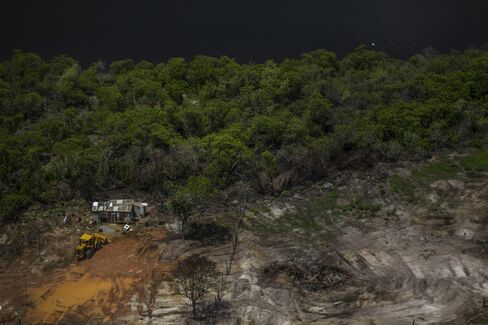
Mangrove trees at the border of Guanabara Bay.
Three of those companies -- builders Queiroz Galvao SA, OAS SA, and Andrade Gutierrez SA -- were responsible for a project to dredge four polluted lagoons and plant 500,000 mangrove trees in Barra da Tijuca, the key staging ground for the games. But work won’t be ready after public prosecutors requested delays and then the state faced cash shortages, according to the Environment Secretariat. A press official for the builders group confirmed that the pace of work has been “reduced” and declined to comment further.
“Rio is the showcase of Brazil -- of its incompetence and impunity,” said Mario Moscatelli, the biologist subcontracted by the construction firms to plant the mangroves. He says he’ll be able to finish less than 10 percent of the work.
Queiroz is also part of the group building the subway line from Ipanema to Barra, which still awaits a nearly 1 billion-real loan from the Rio-based national development bank before it can finish works.
Rio state projects a 20 billion-real deficit this year, of which 12 billion relate to the underwater pension system, and Thursday announced a new round of spending cuts. Almost 70 percent of public-school teachers and workers have been on strike since March as salaries are delayed, their union says. Rio city was forced to take control of two public hospitals, and a doctors’ group warns others may soon close for lack of funding.
The state also slashed its security budget by 32 percent this year and has delayed payments to police and their families. New equipment police expected for the games never materialized, and instead many officers are saddled with obsolete gear, said a high-ranking military police official, who asked not to be identified criticizing the budget cuts.
All major security investments for the Olympics have been carried out since 2012 or are in their final phase, and any personnel or equipment shortage during the games will be covered by federal security agencies, according to the press office of Rio’s security secretariat.
Leonardo Espindola, chief of staff to Rio’s governor, told the Supreme Court in April that the state is on the verge of “social collapse.” State Finance Secretary Julio Bueno agrees. At the outset of an hour-long interview last month, Bueno claimed to have “the worst job in Rio de Janeiro.”
“We’re unable to maintain essential services like police and health,” he said. “That’s what defines the health of a society.”
Monday, June 13, 2016
Hey, Siri, How Will Apple Keep Up With Google and Amazon?
- Apple’s virtual assistant set for prominent role at WWDC
- Updates to Apple Music, iOS, WatchOS and tvOS also expected
Asking Apple Inc.’s voice-activated assistant, Siri, what the company plans to unveil at its Worldwide Developers Conference in San Francisco next week elicits the response: “If I told you, they’d probably make me sit through product security again.”
Witty, perhaps, but Siri will have to supply more satisfying answers if it’s going to convince customers, developers and investors that Apple is keeping pace with Alphabet Inc.’s Google Now and Amazon.com Inc.’s Alexa in one of the hottest emerging areas of tech: virtual personal assistants.

The Echo
Alongside updates to Apple Music and the company’s mobile, watch and television operating systems, Apple will announce that for the first time it will let outside developers integrate Siri with their apps, according to a person familiar with the plans. Getting programmers on board is an essential step toward building tools that make Apple’s devices more indispensable -- such as apps that let you use voice commands on an iPhone or iPad to order a pizza or summon an Uber car, both of which Alexa can already do through the Echo in-home speaker.
“Siri needs to grow up and get smarter, and by being in other apps it will get smarter because it will know more of what I do,” said Carolina Milanesi, an analyst at Creative Strategies in San Jose, California. “It’s like quicksand -- if you move slightly, you sink deeper. It’s another little thing that gets you more entrenched into the ecosystem.”
Technology news website The Information reported in late May that Apple planned to open Siri to apps made by others.
App Ecosystem
Indeed, Apple is trying to pull people deeper into its network of apps and services -- from iTunes to Apple Music and iCloud storage -- to help make up for slowing iPhone sales. The developers conference, which focuses on software, has therefore become more significant for Apple after playing second fiddle to the company’s much-heralded hardware rollouts for years. Chief Executive Officer Tim Cook has repeatedly highlighted the importance of sales from services, which have become the fastest-growing part of Apple’s business.
As part of that drive, Apple earlier this week laid out changes to the App Store. Starting Monday -- the day the conference kicks off in San Francisco -- Apple will halve the portion of sales it takes from developers if customers subscribe to a product for more than a year, and it will let developers pay to get more prominent placement within U.S. App Store searches. A revamped music-streaming service will also feature in the presentation at WWDC, Bloomberg News reported in May.
A consumer shift toward music streaming poses a mounting threat to the $3.5 billion iTunes song-download business, and Apple’s year-old answer to Spotify Ltd. and Pandora Media Inc. has been troubled by tepid critical reception, infighting and executive departures. That’s prompted an overhaul of the $10-per-month Apple Music streaming service, which will be unveiled on Monday and include changes to the interface intended to make it more intuitive to use.
Siri’s Rivals
The race to develop the most useful virtual assistant will help decide whose products consumers use to engage with the digital world. Apple got a head start when it introduced Siri in 2011. Yet in the years since then it has lost ground to Google Now, which followed in July 2012, and Amazon’s Alexa, unveiled in November 2014.
That’s why the audience at Apple’s annual developer confab will pay particular attention to anything software chief Craig Federighi might say about improvements to Siri if he takes the stage at the Bill Graham Auditorium. A Siri developer kit -- the software tools that let programmers create applications -- would increase the number of products and services that iOS users can access through Siri, tying them more closely to Apple devices.

While virtual assistants will play an increasingly important role in the automated home, for now Siri’s abilities are aimed at ensuring customers keep buying iPhones and iPads. Significant improvements to Siri would make about one in five Americans more likely to buy an iPhone, according to a survey by advertising technology company Fluent LLC.
Home Hardware
Amazon released a software development kit for its virtual assistant a year ago and Google did the same in March, just two months before it announced an Echo competitor called Google Home. A Siri SDK could lay the groundwork for a similar piece of hardware from Apple, according to Royal Bank of Canada analyst Amit Daryanani.
Alexa is better than Siri at comprehending different accents and dialects, while Google Now has the edge in understanding the intent of a question and translating that into an action, such as checking your calendar or giving you driving directions, according to Rob May, chief executive of Talla Inc., a Cambridge, Massachusetts-based developer of virtual assistants for businesses. Apple’s advantage lies in its vast network of developers.
“Siri’s definitely behind the game,” May said. “But where Apple is in the lead is that they have the strongest developer ecosystem. As everything moves in the direction of virtual assistants then they have a great basis on which to build it.”
Friday, June 10, 2016
These Are the Best CEOs in America, According to the People Who Work for Them
It's not easy to keep all your employees happy, but these chief executive officers seem to have figured it out.
The CEOs of Bain & Company Inc., Ultimate Software Group, Inc., McKinsey & Company Inc., Facebook Inc., and LinkedIn Corp. took the top five spots a just-released list of the highest-rated CEOs in the U.S. According to a report from career website Glassdoor, each of the CEOs had an employee approval rating of 97 percent or higher.
Last year, Google's Larry Page took the top spot and women were absent from the top 50. This year, four women made the list. The highest-rated female chief executive was In-N-Out Burger’s Lynsi Snyder at No. 17. Staffmark’s Lesa Francis, Enterprise Holdings’ Pamela Nicholson, and Deloitte’s Cathy Engelbert also made the top 50. Other well-known CEOs making their first appearance on the list include Nestlé Purina PetCare’s Joseph Sivewright at No. 9, NBCUniversal’s Stephen Burke at No. 39, and lululemon’s Laurent Potdevinat in 48th place.
Here is a look at the top 25.

Some leaders haven't found the key to keeping employees satisfied, but they came close. Fidelity Investments' Abby Johnson and Chick-fil-A Inc.'s Dan Cathy both had employee approval ratings of 92 percent. Twitter Inc.'s Jack Dorsey had an 88 percent rating, and JetBlue Airways Corp's Robin Hayes had an 87 percent rating.
With a lot of uncertainty about the future at Yahoo! Inc., CEO Marissa Meyer received a mere 64 percent approval rating.
The report is based solely on the input of employees who anonymously and voluntarily provide feedback through Glassdoor, and the CEOs are then ranked according to their overall approval rating from the past year.
Wednesday, June 8, 2016
The 37th Hemispheric Congress: Session for today
Segundo Dia de Sesiones del 37 Congreso Hemisferico:
- Global Expand: The new economy of transformation: Oscar Echevarria, President
- Innovation Technology: Cybersecurity by several specialists
- Trade Agreements and Investments : several business leaders of the continent
- Energy Panel : several specialsts from main power companies
Tuesday, June 7, 2016
Inside Uber’s Auto-Lease Machine, Where Almost Anyone Can Get a Car
And now Wall Street is making a $1 billion bet on Uber's lease business
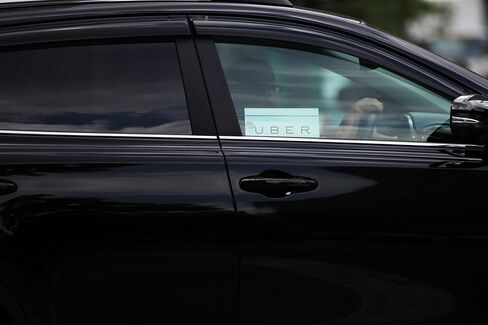
In its relentless pursuit for growth, Uber needs new drivers, and many of those drivers need cars. To help them get started, Uber has been offering short-term leases since July through a wholly owned Delaware-based subsidiary called Xchange Leasing, LLC. It partners with auto dealerships, advertises to drivers, manages risk, and even pays repo men to chase down cars whose drivers aren't making their payments.
Xchange may be key to Uber's continued expansion as it tangles with Lyft in the U.S. and a bevy of competitors abroad. Uber announced a partnership with Toyota last week to finance even more cars. This year, Uber said its financing and discount programs, which include Xchange, will put more than 100,000 drivers on the road. That requires dipping into the vast pool of people with bad or no credit.
In a deal led by Goldman Sachs, Xchange received a $1 billion credit facility to fund new car leases, according to a person familiar with the matter. The deal will help Uber grow its U.S. subprime auto leasing business and it will give many of the world's biggest financial institutions exposure to the company's auto leases. The credit facility is basically a line of credit that Xchange can use to lease out cars to Uber drivers.
Xchange caters to people who have been rejected by other lenders. The program is run by Andrew Chapin, who pitched it to Uber Chief Executive Officer Travis Kalanick in 2012. Before joining Uber, Chapin was a Goldman Sachs commodities trader. He oversees all of Uber's auto-financing efforts, including a partnership with Enterprise Rent-A-Car and vehicle-purchase discounts. "I want the driver to get an option that is best for them," Chapin said. "I try to provide a menu of options that the industry thus far has not provided."
Xchange isn't intended to be a moneymaker, said an Uber spokesman. But it has plenty of critics who accuse the company of looting the pockets of its drivers. The program is plagued by a lot of questions that surround other subprime lending programs aimed at risky borrowers with bad credit. Is Xchange really offering good deals? Does it ensnare drivers with commitments they can't meet? "You can buy the car for what they're charging you in weekly payments," said Greg McBride, chief financial analyst at personal-finance website Bankrate.com. But for many drivers who sign up with Xchange, it's their only option.
The terms of an Xchange lease run 28 pages. Drivers pay a $250 upfront deposit and then make weekly payments to Uber over the course of the three-year life of the lease. As the video promoting the arrangement puts it: "The best part: Payments are automatically deducted from your Uber earnings." At the end of three years, Uber keeps the $250 deposit to release the drivers from the lease. If they want to buy it, they'll need to fork over the residual value of the car, which could run many thousands of dollars. Uber declined to provide an average figure.
Uber's lease is more flexible than most subprime leases, the company said. After the first 30 days of the lease, a driver can return the car to Uber with two weeks notice, without any additional fees, apart from the payments they owe and the $250 they paid up front. Many other leases also charge drivers by the mile if they exceed a certain mileage threshold. Not Xchange, though; Uber wants to incentivize drivers to keep logging miles.
Monday, June 6, 2016
News from the State Attorney's Office
|




Subscribe to:
Posts (Atom)