Friday, August 14, 2015

BUSINESSMEN'S MEETING POINT : Made in Venezuela Business Club

BUSINESSMEN'S MEETING POINT
PUNTO DE ENCUENTRO DE EMPRESARIOS 

Fue un verdadero punto de encuentro. Allí coincidieron un buen número de instituciones que se auto llamaban aliadas y un centenar de profesionales, empresarios, emprendedores en general que proclamaban unidad dentro de la diversidad y que tenían en común el convencimiento de conocerse, hacerse más amigos para trabajar más para beneficio propio y común. Reinó la cordialidad y un entusiasmo contagioso. 

Tony Ortíz, Comisionado del Distrito 2 de la Ciudad de Orlando dio la bienvenida y las palabras iniciales anticipando un éxito rotundo a la institución que esa noche nacía, ofreciendo además el apoyo y respaldo de la Ciudad de Orlando. El maestro de ceremonias fue invitando a participar a cada uno de los representantes de las instituciones aliadas. 

William Diaz, como presidente de la Institución explicó los motivos alcances y goles de Made in Venezuela Business Club. Raúl Lopez-Pérez, Director de CAMACOL y Consejero del Congreso Hemisférico de Cámaras de Comercio e Industria Latinas juramentó a la Junta Directiva y firmó conjuntamente con William Diaz un Memorando de Entendimiento (MOU) entre ambas instituciones. 

El acto concluyó con las bellísimas interpretaciones del virtuoso guitarrista Eudio Barboza y un exquisito brindis con sabrosa comida típica venezolana. 

VISION 
Ser el punto de encuentro de los profesionales, los empresarios y la comunidad en general en el centro de la Florida. 

VISION 
To be the meeting point of professionals, businessmen and the community in general in central Florida.

MISION
Promover la integración, la interrelación y el apoyo mutuo de los empresarios y profesionales Venezolanos ubicados en el Centro de la Florida.

MISSION 
To promote the integration, interrelation and the mutual support of the Venezuelan businessmen and professionals located in Central Florida.

BENEFICIOS 
Directorio de afiliados 
Reuniones y oportunidades de negocios 
Publicidad en la red
Publicidad compartida
Beneficios en seguros y planes de retiro
Descuentos entre afiliados
Fiestas temáticas 
Magno evento anual CAMACOL 

BENEFITS 
Directory of affiliates, 
meetings and business opportunities, 
network publicity, 
shared publicity, 
insurances and retirement plans benefits, 
discounts between affiliates, 
thematic holidays, 
super annual events.

NUESTRO ALIADOS 
Cámara de Comercio Latina de los Estados Unido (CAMACOL) 
Hispanic Chamber of Commerce of Metro Orlando (USHCC) 
Latino Leadership Inc
Casa de Venezuela, Orlando 
Yes Foudation 
He Kids 
Diversos Centrosde Investigación y Académico . 
Diversas Instituciones Oficiales 
Condado Orange

Ciudad de Orlando 

OUR ALLIES 
The Latin Chamber of Commerce of the United States (CAMACOL), Hispanic Chamber of Commerce of Metro Orlando (USHCC), Latin Leadership, Inc., House of Venezuela, Orlando, Yes Foundation, The Kids, Diverse Centers of Investigation and Academia, Diverse Official Institutions, Orange County, City of Orlando.



Thursday, August 13, 2015

The Great American Vacation in Three Charts (BusinessWeek)

Visitors bike past shops in downtown Tulum, Mexico

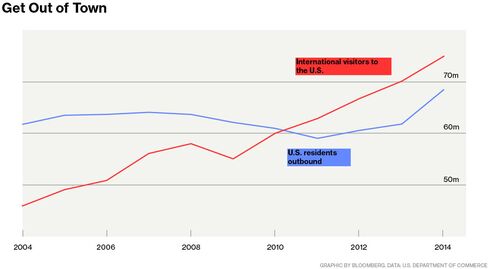
Nearly 70 million Americans traveled abroad last year. Even more people visited the U.S., continuing a trend that began about five years ago amid efforts to reverse a decline in tourism caused by the financial crisis and tighter security. In 2010, Congress created a body to promote tourism in the United States; two years later, the White House followed with an executive order (PDF) aimed at speeding visa approvals.

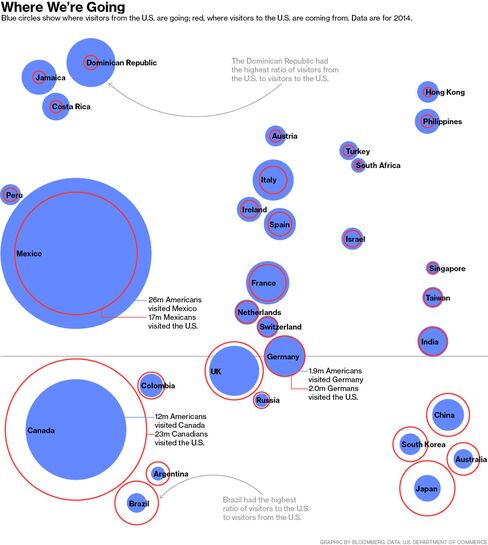
Where do Americans go? Canada and Mexico, of course. Excluding those two, 30.8 million Americans traveled abroad last year, led by Californians and New Yorkers, according to recent data (including both business and leisure travel) from the Commerce Department's National Travel and Tourism Office.


Canadians visit the U.S. more than Americans visit Canada. More than twice as many Americans visited Mexico in 2014 as headed north, those sunny beaches trumping the friendly nation of hockey, poutine, and Justin Bieber. Among overseas destinations, the United Kingdom and the Dominican Republic drew the most U.S. travelers, followed by France, Italy, and Germany.


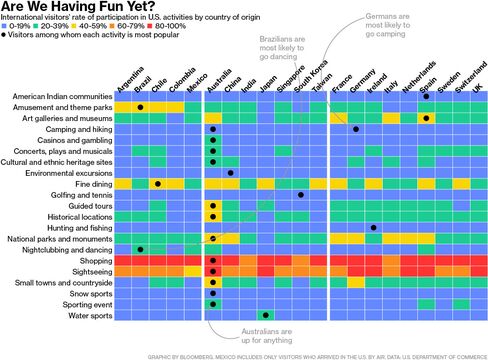
What do tourists do when they come to America? Everybody shops. But nobody enjoys golf and tennis like South Koreans. Chileans prefer U.S.-style fine dining, and Spanish travelers come for the art galleries and Native American cultural attractions. The outlier: Australians, who apparently don't go in for sleep.


Tuesday, August 11, 2015

Monday, August 10, 2015

Attackers can access Dropbox, Google Drive, OneDrive files without a user's password (CNet)

The so-called "man-in-the-cloud" attack is said to be a common flaw in most cloud-based file synchronization services.
ropbox is one of those affected by this cloud vulnerability (Image: CNET)

Hackers don't even need your password anymore to get access to your cloud data.

Newly published research, released at the Black Hat conference in Las Vegas on Wednesday by security firm Imperva, shows how a "man-in-the-cloud" attack can grab cloud-based files -- as well as infecting users with malware -- without users even noticing.
The attack differs from traditional man-in-the-middle attacks, which rely on tapping data in transit between two servers or users, because it exploits a vulnerability in the design of many file synchronization offerings, including Google, Box, Microsoft, and Dropbox services.

This is not just an issue for consumers, but also businesses, which increasingly use cloud-based services to share sensitive customer and corporate data.

The report by Imperva, which has a research unit as well as having a commercial stake in the security space, said in some cases "recovery of the account from this type of compromise is not always feasible."

The attack works by grabbing the password token, a small file that sits on a user's devices for convenience (which saves the user from entering their password each time). When the token is obtained, either through a phishing attack or a drive-by exploit, it can be used to fool a new machine into thinking the attacker is the account's owner. From there, the attacker can access and steal files, and even add malware or ransomware (which is on the rise) to the victim's cloud folder, which can be used for further attacks.

Making matters worse, account owners are almost powerless. Because the tokens are tied to the user's device, changing the account password would not lock out the attacker.

"We should be really worried about this," said Amichai Schulman, chief technology office at Imperva, speaking to ZDNet on the phone earlier this week. "Attackers are looking at methods of being less detectable. But the reality is that it's already happening."

Recent research pointed to a sophisticated Russian hacker group targeting the cloud with Hammertoss, malware which sifts through network traffic, looking for ways to pilfer files and documents. Imperva also cited a paper by security firm Blue Coat, which showed a similar attack method in the wild.

But coming to the defense of the cloud providers, Schulman was somewhat hesitant to call the vulnerability a flat-out "design flaw."

"These services are meant to deliver files seamlessly from your computer to the cloud to other devices around the world. These services aren't dangerous or insecure," he added.

"It's kind of a trade-off between usability and security. It's just the way things work," he said.

"There isn't a simple fix," he said. Although many services now offer two-factor authentication and notifications when unauthorized access is detected -- such as from a new computer or an entirely different geography -- Schulman said many people either ignore those notifications or choose not to do anything about them.

Dropbox declined to comment on the record. Google did not return an email requesting comment.

Friday, August 7, 2015

Islamic State Circulates Sex Slave Price List (BusinessWeek)

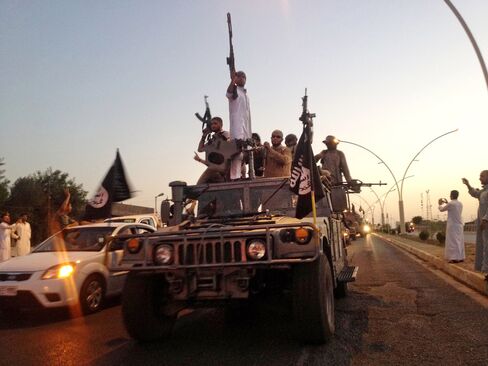
FILE - In this photo taken Monday, June 23, 2014, fighters from the Islamic State group parade in a commandeered Iraqi security forces armored vehicle down a main road at the northern city of Mosul, Iraq. An independent monitoring group says some bombings carried out by the U.S.-led coalition targeting the Islamic State group likely have killed hundreds of civilians. The coalition had no immediate comment on the report released Monday, Aug. 3, 2015. (AP Photo, File)

A senior United Nations official says Islamic State is circulating a slave price list for captured women and children, and that the group’s ongoing appeal and barbarity pose an unprecedented challenge.

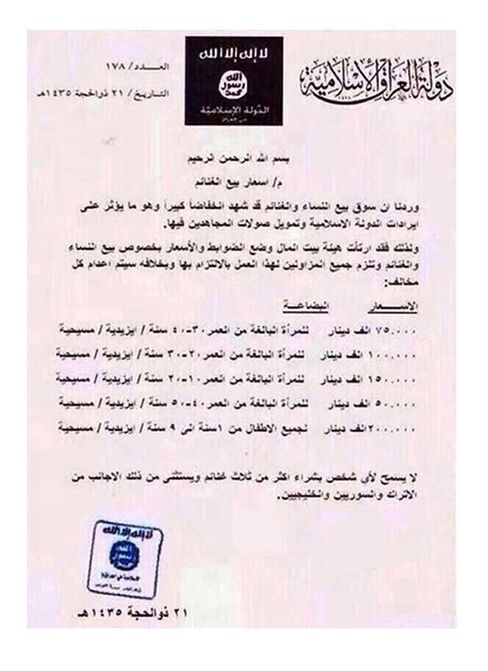
The official, Zainab Bangura, said that on a trip to Iraq in April she was given a copy of an Islamic State pamphlet, which included the list, showing that captured children as young as one fetch the highest price. The bidders include both the group’s own fighters and wealthy Middle Easterners.

The list shows the group’s view of the value of those it captures and surfaced some eight months ago, though its authenticity came under question. Bangura, who is the UN special envoy on sexual violence in conflict and was also in Jordan and Turkey, said she has verified that the document came from Islamic State and reflects real transactions.

“The girls get peddled like barrels of petrol,” she said in an interview last week in New York. “One girl can be sold and bought by five or six different men. Sometimes these fighters sell the girls back to their families for thousands of dollars of ransom.”

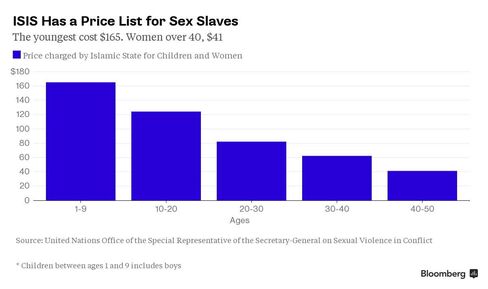
For Islamic State fighters, the prices in Iraqi dinars for boys and girls aged 1 to 9 are equal to about $165, Bangura said. Prices for adolescent girls are $124 and it’s less for women over 20.

The militia’s leaders first take those they wish, after which rich outsiders from the region are permitted to bid thousands of dollars, Bangura said. Those remaining are then offered to the group’s fighters for the listed prices.

Verified List

Bangura, a Muslim and former foreign minister of Sierra Leone, said that Islamic State, which rules some 80,000 square miles across swathes of Iraq and Syria, is unlike other insurgent groups and challenges all known models of fighting them.

“It’s not an ordinary rebel group,” she said. “When you dismiss them as such, then you are using the tools you are used to. This is different. They have the combination of a conventional military and a well-run organized state.”

Officials and scholars have struggled to understand Islamic State’s success despite breaking what are widely seen as rules for insurgents -- to be sure to mingle with local populations, not take on established militaries or try to hold territory. The group has broken all those rules and draws thousands of foreign fighters despite its well-publicized savagery.
Below is a scanned copy of the list obtained and verified by the UN

Spread Fear

Kerry Crawford, who teaches at James Madison University in Harrisonburg, Virginia, said that publicizing the violations is used to the group’s advantage by building internal ties and external fear.

“If you and your group are doing something that is considered taboo, your doing it together forms a bond,” she said. “Sexual violence does really create fear within a population.”

She also said that sexual abuse by soldiers has a long history including the so-called rape camps in the former Yugoslavia in the 1990s.

Islamic State has made a particular practice of enslaving communities it has conquered that are not Sunni Muslim -- Yazidis and Christians, for example. 

It portrays such conquests as God’s work, drawing disaffected Muslims from around the world.

Bangura said the international community and the UN have been taken aback by such practices because they do not resemble those of village militias in other countries.

“They have a machinery, they have a program,” she said. “They have a manual on how you treat these women. They have a marriage bureau which organizes all of these ‘marriages’ and the sale of women. They have a price list.”


Thursday, August 6, 2015

FBI:Public Service Announcement (I-073115-PSA)

Alert NumberIC3 Logo

July 31, 2015 

Alert  Number 

I-073115-PSA