Monday, July 18, 2016

How to: Download Movies/TV Shows to watch when there is not Internet connection

How to Download Movies and TV Shows to Watch Them on an Airplane (or Anywhere Else Offline)


Solid Internet connections aren’t available everywhere. If you want to watch streaming movies and TV shows on an airplane, on the subway, or somewhere out in the wilderness away from cellular towers, you can download them ahead of time.

Not every service offers a download feature, but quite a few services allow you to download videos ahead of time so you can take them with you. This could save lots of valuable cellular data, too, especially if you’re roaming internationally. Let’s take a look at some of your options.

Amazon Prime

The Amazon Video app available for iPhones and iPadsAndroid devices, and Amazon’s own Kindle Fires allows you to download videos to your device so you can watch them offline.

Just download the app and sign in with your Amazon account. Find the movie or TV show you want to watch and tap the “Download” button to the right of it. Downloaded videos will appear in the “Downloads” section of the app later, so you can open the app and watch them–even without an Internet connection.

This feature is only available in the Amazon Video apps for iOS, Android, and Amazon’s Fire OS. You can’t do this from the website, so you can’t do it on a laptop. You need a smartphone or a tablet–and not a Windows tablet.


YouTube Red

YouTube offers this feature, but only if you pay for YouTube Red (which actually isn’t a bad deal if you use Google Play Music, which is included–you get both Google Play Music’s music library as well as YouTube Red for the same price you’d pay for Spotify or Apple Music.)
To download a video, open the YouTube app on an iPhone, iPad, or Android device and tap the menu button next to a video. Tap “Save Offline” and you’ll be prompted to choose which resolution you want to download the video in. Higher resolutions offer a better quality video, but take more space on your device.
You’ll find the videos you saved for offline use under the profile tab. Tap “Offline Videos” and you’ll see a list of videos you can watch offline.
This feature is only available in the YouTube app for iPhones, iPads, and Android devices. You can’t do this from the YouTube website, so you can’t do it on a laptop.

Video Rentals and Purchases

Amazon and YouTube both offer this feature as part of their streaming plans, which is convenient. However, you can gain access to a much wider selection of videos if you’re willing to pay per video–either as a temporary rental or as a purchase you can watch as much as you want.
This is also convenient because some of these services allow you to download videos to a Windows PC, Mac, or Chromebook. You can save videos and watch them on a laptop or a Windows tablet, while Amazon and YouTube only offer this feature in their mobile apps.
You have quite a few options here, including:
  • iTunes (Windows, Mac, iOS): Apple’s iTunes is available for Windows and included on Mac, iPhone, and iPad. It allows you to rent movies, purchase individual episodes or entire seasons of TV shows, or purchase movies. If you choose to rent a movie, you’ll have thirty days to start watching it. After you start watching it, you’ll have 24 hours to finish. if you plan on going for a trip, you can rent several movies from iTunes, download them to your Windows PC, Mac, iPhone, or iPad and get around to watching them any time within 30 days without an Internet connection. If you purchase an episode of a TV show or entire movie, you can download it and watch it whenever you want with no expiration.

  • Amazon Video (iOS, Android, Kindle Fire): In addition to the library of free videos available with Amazon Prime, Amazon allows you to rent and purchase individual movies and TV show episodes. However, you can’t download purchased videos to your computer for offline watching–you can only download them to the Amazon Video app on iOS, Android, or Kindle Fire.
  • VUDU (iOS, Android): Walmart’s VUDU also allows you to rent and purchase movies and TV shows as well, but videos can only be downloaded to iPhones, iPads, and Android devices. Laptop users are out of luck.
  • Microsoft Windows Store (Windows 10): Windows 10 includes the Windows Store, and the Windows Store includes an entire “Movies & TV” section offering video rentals and purchases. Videos you pay for can then be watched in the Movies & TV app included with Windows 10. This is the main alternative to iTunes for purchasing and watching videos offline on a Windows PC.

  • Google Play Movies & TV (Android, iOS, Chrome OS): On Android devices, the Google Play Movies & TV app provides rentals of movie and TV shows. The Google Play Movies & TV app is also available oniPhone and iPad, and both platforms allow you to download videos offline and watch them in the app. Google offers a Google Play Movies & TV Chrome app that allows you to download and watch videos offline, but this feature only works on Chromebooks. It’s the only option for Chrome OS devices.

Rip Your Own DVDs or Blu-rays

RELATED ARTICLE

Are you looking for a way to convert your DVD collection to high quality MP4 files? Today we are going to take a look at using DVDFab HD Decrypter along with Handbrake to convert DVDs to MP4 using the H.264 codec.[Read Article]
Lastly, if you have movies or TV shows on physical DVD or Blu-ray discs, you can “rip” them to digital video files you can more easily take with you. Store these files on a laptop, smartphone, or tablet and you can watch them without taking the disc with you.

You can rip DVDs and Blu-rays with a variety of programs, but we particularly like Handbrake–it’s free, and contains presets for ripping files compatible with iPhone, iPad, Android, and more.

Netflix doesn’t yet offer this feature, but rumors suggest Netflix is working on it. If and when Netflix does offer this feature, it will likely work in a similar way to the Amazon Video and YouTube apps.

Thursday, July 14, 2016

Why forensics investigators must handle solid-state drives with care

Don't assume that hard-disk forensics tools work the same on solid-state drives.


Do your homework before performing forensics research on a budget-priced solid-state drive—or before trusting such drives to erase your data.

That's the message from Tom Kopchak, a disk encryption expert at Hurricane Labs, which is a managed security provider in Independence, Ohio.

Kopchak said he's done extensive research on the forensic differences between traditional hard-disk drives and modern SSDs. His work is applicable to law enforcement, electronic discovery (the software process used by attorneys to gather digital evidence), and anyone who wants to make sure their "delete" button does what it says.

Kopchak plans to present his full research, 101 Sentient Storage — Do SSDs have a mind of their own?, on Aug. 5, 2016 at the Defcon 24 conference in Las Vegas. "The goal of this study was to demonstrate and quantify differences across a sample pool of drives in an array of tests conducted in a controlled environment. These tests explored the variations between drive firmware, controllers, interfaces, operating systems, and TRIM state," he wrote in the session description. "This presentation will demonstrate these differences and provide a framework to allow forensics investigators to determine the likelihood of successful deleted file recovery from an evidence bearing solid state drive."

Asked to further explain his work, Kopchak told TechRepublic he's long had an interest in this subject but could not find enough existing research. Although it's only partially related to his work at Hurricane Labs, "This is more of something I've been interested in, and it's one of those areas which kind of lack information that I've been able to find," he said. "It seems there's one [paper] every year, year-and-a-half, or two that comes out for this sort of thing.

"There are a pair of incorrect assumptions which are prevalent. First, law enforcement and forensic technicians too often assume that tools made for HDDs will work exactly the same on SSDs. Second, even when people do understand that SSDs behave different from HDDs, they still assume that all SSDs work the same."

Kopchak also found in his research that pricier, more mature SSDs delete files and leave fewer traces behind than budget models. This is an important consideration for anyone purchasing enterprise drives, he said.

"When you look at something used in an enterprise SAN array for example, fundamentally they'll operate similarly [to hard drives]," he continued. "The work that I did just cracks the surface. It draws attention to investigators needing to be aware of these differences."

As such, black-hat hackers and anyone who is concerned about privacy should probably use a high-end SSD, not a budget model or a traditional hard disk, Kopchak said. The fewer digital trails your computer leaves behind, the harder it is for investigators to recreate your data.

Tuesday, July 12, 2016

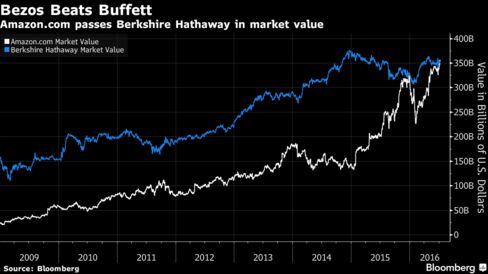
Bezos Beats Buffett as Amazon Market Value Tops Berkshire

Amazon Tops Berkshire's Revenue Growth


Amazon.com Inc., Jeff Bezos’s online retailer, moved past Warren Buffett’s Berkshire Hathaway Inc. to become one of the world’s five largest companies by market value on Monday, according to data compiled by Bloomberg. Amazon rose as high as $356.5 billion in the first two hours of trading. The company surpassed Berkshire on the day before Prime Day, an annual promotion.

Monday, July 11, 2016

Airbus Is Running Out of Buyers ...

...for Its Enormous A380s...

Orders for the superjumbo are drying up as airlines shift to more efficient planes.


1467918589_comp_airbus29

Since its commercial introduction in 2007, the Airbus A380 has brought a long-lost sense of glamour back to travel. Its first-class cabins feature private showers and buttery leather armchairs. It sports in-flight lounges where bartenders mix bespoke cocktails. A broad staircase reminiscent of a 1920s ocean liner links the two decks. Financially speaking, it’s a disaster of similarly grand proportions.

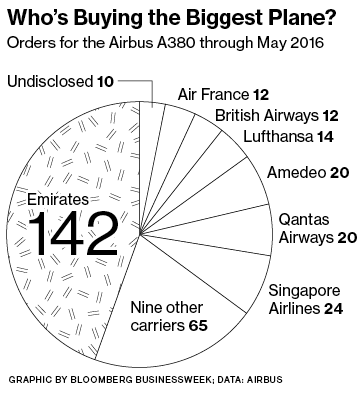
An initial flood of interest from airlines has turned into a slow drip, and Airbus is leaning heavily on one customer, Emirates, for sales. Not a single U.S. carrier has bought one, and Japanese airlines, among the biggest cheerleaders for huge planes, have taken just a handful. Airbus has delivered 193 A380s—early on it predicted airlines would buy 1,200 supersize planes over two decades—and has only 126 in its order book, to be built over the next five years or so. Worse, many orders appear squishy, because airlines are shifting away from superjumbos. As the aviation world starts gathering on July 11 for the Farnborough International Airshow in England, where carriers often announce big orders, there’s little indication any A380 contract will be unveiled.

Airbus concedes its timing was off with the A380, which lists for $433 million but almost always sells at a discount. The financial crisis hit just as production was picking up in 2008, and soaring oil prices made airlines reluctant to buy the four-engine behemoth. The company only last year managed to start breaking even on production, and it’s acknowledged it will never recoup the €25 billion ($32 billion) it spent on development. Zafar Khan, an analyst at Société Générale, says the concern is that if production slips far below 30 planes a year, the program could fall back into the red. “The crying happens when it’s losing money,” Khan says.

Axing the A380 outright is hard to do. Besides the embarrassment of admitting defeat on the program, Airbus would need to write off factories across Europe and redeploy thousands of workers. Airlines would see the resale value of their A380s plummet, and the plane’s demise would leave airports worldwide questioning the wisdom of facilities constructed to accommodate it; Dubai, for instance, built a dedicated terminal for the A380.

Airbus says 10 years is too short a time to determine its fate. While Chief Executive Officer Thomas Enders said in December the company would assess the plane’s future “in cold blood,” sales chief John Leahy has pledged to continue the program. “The A380 is here to stay,” he says. “We are maintaining, innovating, and investing in it.”

With its short snout and upper deck crouching above the cockpit, the A380 can’t match the distinctive profile of Boeing’s humpbacked 747. Nonetheless, the A380 has largely sucked the life out of Boeing’s jumbo—perhaps the biggest Airbus success with its plane. Since 2012, when Boeing started deliveries of the latest passenger version, the 747-8, it has done far worse than the Airbus double-decker, with just 40 sold and 11 more on order.

Four-engine planes have become a tough sell because of their high fuel consumption. Airbus in 2011 scrapped the A340, its other four-engine model, as carriers gravitated to smaller, more economical widebodies such as the Airbus A330 or Boeing 777; and adding more fuel-efficient engines to the A380, an upgrade Airbus has pulled off for smaller planes, remains risky with so few orders coming in. Although the A380 is popular with passengers for its spacious interior and smooth flight, carriers find it tough to fill in turbulent economic times. Malaysia Airlines learned this the hard way when, in the wake of a pair of fatal crashes involving other aircraft, it couldn’t draw enough traffic to fill the half-dozen A380s it had bought. The airline is trying to offload two of them but can’t find buyers.

Lately, Airbus has seen a hemorrhaging of contracts that once seemed solid. In the past two years, three A380 customers have dropped their orders because of financial difficulties or shifts in strategy. Leasing company Amedeo three years ago announced plans to buy 20 A380s, but it’s failed to find a single airline willing to lease them and has delayed deliveries. The plane’s biggest fan by far is Emirates, with 81 flying and an additional 61 reserved, which adds up to 45 percent of the A380s Airbus has delivered or has on order. The carrier is fretting about the jumbo’s future. “I think the size of the plane scares most of the airline world,” says Emirates President Tim Clark.

The A380 was a prestige-fueled project for Airbus and the European governments that backed the program. The company had been successful with its A320 single-aisle jet introduced in the 1980s, but it wanted a bigger piece of the lucrative long-range market. With the managers who hatched the plan two decades ago long gone, the ardor has abated, says Richard Aboulafia, a longtime critic of the plane and vice president of aviation consultant Teal Group. “Nobody seems to want this plane other than Emirates,” he says. “The A380 might just make it until 2020, but even that’s almost optimistic at this point.”

The bottom line: A decade after the Airbus A380’s debut, its future is in doubt as airlines shift to more efficient planes.

Friday, July 8, 2016

Do You Own Your Own Fingerprints? (BW)

An obscure law could lead to broader limits on biometrics.
1467840328_tech_biometrics29

These days, many of us regularly feed pieces of ourselves into machines for convenience and security. Our fingerprints unlock our smartphones, and companies are experimenting with more novel biometric markers—voice, heartbeat, grip—as ID for banking and other transactions. But there are almost no laws in place to control how companies use such information. Nor is it clear what rights people have to protect scans of their retinas or the contours of their face from cataloging by the private sector.

There’s one place where people seeking privacy protections can turn: the courts. A series of plaintiffs are suing tech giants, including Facebook and Google, under a little-used Illinois law. The Biometric Information Privacy Act, passed in 2008, is one of the only statutes in the U.S. that sets limits on the ways companies can handle data such as fingerprints, voiceprints, and retinal scans. 

At least four of the suits filed under BIPA are moving forward. “These cases are important to scope out the existing law, perhaps point out places where the law could be improved, and set principles that other states might follow,” says Jeffrey Neuburger, a partner at law firm Proskauer Rose.

The bankruptcy of fingerprint-scanning company Pay By Touch spurred BIPA’s passage. Hundreds of Illinois grocery stores and gas stations used its technology, allowing customers to pay with the tap of a finger. As the bankrupt company proposed selling its database, the Illinois chapter of the American Civil Liberties Union drafted what became BIPA, and the bill passed with little corporate opposition, says Mary Dixon, legislative director of the Illinois ACLU.

Under the Illinois law, companies must obtain written consent from customers before collecting their biometric data. They also must declare a point at which they’ll destroy the data, and they must not sell it. BIPA allows for damages of $5,000 per violation. “Social Security numbers, when compromised, can be changed,” the law reads. “Biometrics, however, are biologically unique to the individual; therefore, once compromised, the individual has no recourse, [and] is at heightened risk for identity theft.”

In April 2015, Chicagoan Carlo Licata, a Morgan Stanley financial adviser, sued Facebook under BIPA, arguing that the company violated his privacy by using its facial-recognition software to create a detailed geometric map of his face and tag him in photos. 

Two more Illinois residents filed complaints against Facebook the following month. That June a logistics engineer and paratriathlete named Brian Norberg brought an almost identical suit against the photo-sharing site Shutterfly. Two more plaintiffs sued video game publisher Take-Two Interactive Software on similar grounds in October, and two more went after Google in March. The companies declined to comment for this story.

“I think people had really imagined, well, biometrics, it’s got to be an in-person thing. You walk in front of a facial scanner,” says Mark Eisen, a lawyer at Sheppard Mullin in Chicago who specializes in consumer privacy and class-action suits. (He’s not involved in any of the cases.) “So that first lawsuit got a lot of attention, and follow-up lawsuits happened pretty quickly.” Most of the suits focus on photo tagging; in Take-Two’s case, the plaintiffs are worried about the game maker’s creation of realistic digital look-alikes using their facial profiles.

Take-Two has argued that the plaintiffs lack standing because they haven’t claimed harm. The lawsuit against Shutterfly survived a motion to dismiss in December and ended with an undisclosed settlement in April. In the Facebook suit, the plaintiffs are seeking information about, among other things, Facebook’s marketing of and third-party access to its faceprint database. Facebook is arguing that BIPA was meant to apply to physical facial scans and shouldn’t apply to photos.

The Facebook plaintiffs, whose cases have been consolidated in California, where the company is based, passed a crucial test in May. Facebook had argued that according to its terms of use, disputes should be handled under California law, which lacks BIPA-style protections for biometric data. The judge didn’t agree, ruling that BIPA applies. In a June 29 filing, Facebook made the same argument as Take-Two—that the plaintiffs lack standing to sue because they haven’t claimed harm. Google, meanwhile, is challenging BIPA as unconstitutional on the grounds that one state can’t set rules for the rest of the country.

National efforts to establish biometric guidelines haven’t gone well. In 2014 a Department of Commerce agency led an effort to develop a code of conduct for companies using facial-recognition technology, but consumer advocates withdrew from the group the following year, saying tech companies refused to consider the most modest of privacy protections. The effort yielded an unenforceable set of privacy recommendations, published in June.

Part of the problem is that government agencies often have an interest in looser consumer protections. In May the Department of Justice proposed exempting the FBI’s facial-recognition program, called Next Generation Identification, from privacy protections. In June the Government Accountability Office reported that the FBI program failed tests of accuracy and privacy. So far the report hasn’t led to any action.

In Canada and Europe, Facebook stopped offering tag suggestions on photos following pressure from regulators to obtain consent to collect people’s images. In the U.S., BIPA has become a target. Just before Memorial Day, with the Illinois legislature rushing to finish its session, Democratic state Senator Terry Link proposed an amendment to the statute that would have excluded photos and digital images from protection and neatly undercut the lawsuits. 

The ACLU’s Dixon says the amendment was Facebook’s doing. Link declined to comment. Following outrage from advocacy groups such as the ACLU and the Electronic Frontier Foundation (EFF), it was shelved without a vote, but there’s nothing stopping its reintroduction.

“This measure was introduced right before the Memorial Day weekend and could have been passed and changed the law over that weekend,” says Jennifer Lynch, a senior staff attorney at EFF. “If we only have one state with a law that protects use from commercial biometric data collection, and it’s so easy to change that law, it just shows how tenuous the protections on our privacy are.”

The bottom line: For now, an Illinois statute is the strongest check on corporate use of biometric data such as fingerprints and facial profiles.

Thursday, July 7, 2016

Barred Opioid Withdrawal and Addiction Claims

FTC@100 Banner

The marketers of Elimidrol, a powdered drink mix touted as enabling opiate-addicted consumers to overcome addiction and withdrawal, have settled an FTC complaint that their claims were false and misleading.

The proposed stipulated order requires Sunrise Nutraceuticals, LLC, and its principal, Joshua Erickson, to have competent and reliable scientific evidence to back up claims for opiate-treatment products, bars deceptive claims for any health-related products, and requires them to pay $235,000 as redress or disgorgement.

“Opiate addiction has taken a tremendous toll on the American public,” said Jessica Rich, Director of the FTC’s Bureau of Consumer Protection. “By peddling their unproven product, these defendants have prevented people from seeking legitimate treatment.”

In a complaint filed in November 2015, the FTC charged that Sunrise Nutraceuticals, LLC, deceptively claimed that Elimidrol, a powder containing vitamins, minerals, and herbs, alleviates opiate withdrawal symptoms to enable consumers to overcome withdrawal and also increases consumers’ likelihood of overcoming opiate addiction. On January 8, 2016, the FTC voted 4-0 to add Joshua Erickson as a defendant in the case.

Sunrise Nutraceuticals, of Boca Raton, Florida, ran advertising on the Internet, including its www.elimidrol.com website, allegedly targeting opiate-dependent consumers with claims that Elimidrol has a “high success rate . . . in overcoming opiate withdrawal” and “turns up the chances of a successful recovery.”

The company’s ads claimed that Elimidrol will help users “permanently overcome withdrawal – the first time” and “leave addiction behind permanently.” Sunrise also claimed that “Elimidrol is the difference between just another failed attempt and lifelong success.” The FTC charged that these claims were not substantiated.

The proposed stipulated court order prohibits Erickson and Sunrise Nutraceuticals from making claims regarding the treatment of opiate dependence, addiction, or withdrawal, unless they have competent and reliable human clinical testing to support such claims. The defendants also must have such testing to support claims that a product cures, mitigates, or treats any other disease, including claims relating to other substance use disorders. In addition, the defendants must have competent and reliable scientific evidence for efficacy claims for any health-related product.

Finally, the proposed order imposes a judgment of $1,398,037, with all but $235,000 suspended based on the defendants’ ability to pay. If they are later found to have misrepresented their financial condition, the entire judgment will become due.

The FTC is a member of the National Prevention Council, which provides coordination and leadership at the federal level regarding prevention, wellness, and health promotion practices. This case is part of the FTC’s ongoing efforts to protect consumers from misleading health advertising and advances the National Prevention Council’s goal of increasing the number of Americans who are healthy at every stage of life. The FTC thanks the Office of Dietary Supplement Programs in the Center for Food Safety and Applied Nutrition at the U.S. Food and Drug Administration for its assistance.

The Commission vote approving the stipulated final judgment and order was 3-0. The FTC filed the proposed order in the U.S. District Court for the Southern District of Florida, West Palm Division.

NOTE: Stipulated final orders are subject to court approval and have the force of law when signed by the District Court judge.

The Federal Trade Commission works to promote competition, and protect and educate consumers. You can learn more about consumer topics and file a consumer complaint online or by calling 1-877-FTC-HELP (382-4357). Like the FTC on Facebook, follow us on Twitter, read our blogs and subscribe to press releases for the latest FTC news and resources.

Contact Information

MEDIA CONTACT:
Mitchell J. Katz
Office of Public Affairs
202-326-2161

STAFF CONTACT:
Edwin Rodriguez
Bureau of Consumer Protection
202-326-3147

Related Cases

More news from the FTC >>


Wednesday, July 6, 2016

Millions of Chinese Stream Reality Shows Starring Themselves

One popular video featured the nation’s richest man playing poker. Startups and web giants alike are cashing in by selling virtual gifts to people keen to reward popular live-streamers.

Pole dancing, bungee jumping, a woman eating maggots: at any given hour, millions of Chinese are live-streaming all of this and much more on their smartphones.

Crazes come and go at neck-snapping speed in the world’s largest online marketplace, but China’s live-streaming phenomenon shows staying power and is already a significant business. Tiny startups and internet giants alike are making money selling virtual gifts—flowers, cars, toys—to people keen to reward their favorite live-streamers. As the business matures, Alibaba Group Holding Ltd. and others may start selling ads on the most popular streams.

 "This isn’t a fad that will disappear, as the business model has proven to be viable," said Zhu Xiaohu, managing partner at GSR Ventures Management Co., who invested in Inke, one of about 200 live-streaming startups that have attracted an estimated $750 million in venture capital. "But the amount of interest in this sector is so high, bubbles could be forming and many will fail."

In the U.S., tech companies are eager to make live streaming more popular. Twitter Inc. last year acquired the app Periscope and has integrated live video into its main product. Facebook has made it possible for users to stream live and has boosted the prominence of such broadcasts in its news feed. Mobile app YouNow has taken off among teens.

But the Chinese version of live-streaming has caught on much more quickly and broadly. Tens of millions of young people (many of them single men) live in soulless megalopolises far from where they grew up and are seeking human connection—even if it means watching and interacting with a stranger eating dinner. "China’s wide adoption of mobile phones and the loneliness brought on by a fast-paced migrating society means people are more willing to connect this way," says Jia Wei, who runs the live-streaming division for Nasdaq-listed social media app Momo Inc.

Many streams—known as showrooms—feature ordinary people doing remarkably ordinary things. Zhou Xiaohu, a 30-year-old safety foreman at a construction site in Inner Mongolia, is one of 10 million active users on Inke, a two-year-old Beijing startup. Like many Inke users, Zhou logs on after work and watches until bedtime. Zhou, who’s single and bored, flicks through other people’s showrooms and sometimes streams footage of himself eating dinner and watching television. He has plenty to choose from; as many as 60,000 people are broadcasting at the same time.

“It satisfies my needs,” says Zhou, who has spent about 700 yuan ($105) gifting people he follows and earned about 200 yuan in return. “Think of it as a substitute for TV shows and games.”

Li Wenqi, a 31-year-old Chinese hairdresser based in Kobe, Japan, takes followers to tourist attractions and dining spots. A tour of Tokyo’s red-light district is his most popular stream so far. More than 3,000 people watched as Li wandered the neighborhood for about six hours—even though he never ventured indoors. "I just have this urge to share," he says. "I want others who haven’t been to Japan before to know what it’s like here."

Li has delegated two trusted fans to maintain order in his showroom; they can silence or kick out viewers who use vulgar language or stir up trouble. Two months into his sideline, Li has earned about 15,000 yuan from virtual gifts sent by fans on Momo’s app. 
Wang Jianlin.
Wang Jianlin

The most popular streams attract as many has 400,000 people at a time. They often feature famous people. Wang Jianlin, founder of real estate colossus Dalian Wanda Group, streamed video of himself playing poker with associates on a private jet via an app backed by his son. More than 300,000 people watched, and many sent virtual gifts to China’s richest man. Many showrooms feature women wearing revealing clothes and doing pretty much anything that comes to mind—shopping, playing video games, seductively eating fruit.

Top streamers earn hundreds of thousands of dollars a month, according to Momo’s Jia. They get as much as 50 percent of the revenue generated from admirers’ virtual gifts; the hosting companies keep the rest. While streaming is a relatively small chunk of revenue for big companies like Alibaba and Tencent Holdings Ltd., the addictive videos are a useful way to keep users locked into their sites. Smaller companies are doing a thriving business. In the first quarter, Momo generated $15.6 million in gift commissions.

In an effort to stand out on camera, live streamers have been known to pull crazy stunts—drinking themselves into oblivion, say, or munching maggots. China’s regulators are watching and cracking down on anything deemed pornographic or a potential danger to the state. When dozens of young women popped up online suggestively eating bananas, the authorities were quick to kick them off the web. The official scrutiny has forced companies to hire teams of censors; at Inke 1,000 people screen every showroom for content that’s critical of the government, pornographic or violent.

Censorship isn’t much of a concern for Li since he focuses mostly on travel and leisure in Japan. "I enjoy interacting with other people this way," he says. "It’s much faster and more gratifying than other forms of social media."