 |
|||
|

Tuesday, June 21, 2016
Fraud through the phones...

Monday, June 20, 2016



Friday, June 17, 2016
CAMACOL - Miami Marlins : Domino Tournament, June 25 @ Miami Marlins Stadium
On Saturday, June 25 at 12:00 pm, CAMACOL will be
celebrating its 2nd Annual Camacol-Miami Marlins Domino Tournament at the
Marlins Park to benefit our Christmas Food Giveaway Program.
Tickets price is $75 per adults and $50 per kid
under 18. And I can assure you that a Ticket Has Never Included So Much!
Ticket includes among other things:
-
Domino Tournament (playing or observing)-
-
Open Bar and appetizers during the Tournament (from 12:00 pm to 3:00 pm)
- The
game Chicago Cubs vs. Miami Marlins, seat in the Lexus Level.
- All
you can eat free from Marlins Concession Stand from 3:00 PM to 7th
Inning.
To attend, please fill the Registration Form:
The
2nd Annual Domino Tournament
2do
Torneo Anual de Dominó
CAMACOL - MIAMI MARLINS
June 25, 2016 / Junio 25 del 2016
12:00
p.m. - 3:00 p.m.
NAME/NOMBRE:
|
COMPANY/COMPAÑIA:
|
ADDRESS/DIRECCION:
|
CITY/CIUDAD ZIP CODE
STATE/ESTADO
|
TEAM/EQUIPO:
|
PHONE:
CELL:
|
EMAIL:
|
Tournament Rules/Reglas del Torneo:
Participants should be at the assigned entrance at Marlins Park no
later than 11:45
a.m.
Participants who arrive after the start of the tournament will not be
able to play and the cost of the ticket will not be refunded.
Los participantes
deberán estar en el lugar indicado del Marlins Park a las 11:45 a.m.
Participantes que
lleguen después de comenzado el torneo no podrán jugar y no se devolverá el
costo del boleto.
Thursday, June 16, 2016
Obama’s Web Rules Upheld ...
... in Win for Google, Loss for AT&T
- Ruling backs equal access for internet content companies
- Court decision is a defeat for AT&T, Verizon, Comcast
A federal court upheld net-neutrality regulations designed to ensure an open internet, handing a victory to the Obama administration and a defeat to telephone and cable providers.
The Washington-based U.S. Court of Appeals Tuesday acted after a decade of debate over web access that pitted Silicon Valley against companies that provide internet access to homes and businesses. The court likened internet service providers to utilities, saying they “act as neutral, indiscriminate platforms for transmission of speech.”
The ruling is a triumph for the Federal Communications Commission’s Democratic majority that passed the rules last year. It is a win for Alphabet Inc.’s Google, online video provider Netflix Inc. and others who championed the notion of an open internet where internet service providers are prevented from offering speedier lanes to those willing to pay extra for them.
“The open internet rules are here to stay,” Pantelis Michalopoulos, an attorney who represented Netflix and Dish Network Corp. in the case, said in an e-mail. “There is no doubt who is the winner: the open internet. The gatekeepers may not block or throttle our information. They may not ask information to pay tolls.”
Challengers including AT&T Inc., Verizon Communications Inc. and Comcast Corp. said the rule would discourage innovation and investment. AT&T said it would appeal to the U.S. Supreme Court.
‘Unfettered Access’
The three-judge appellate panel heard arguments on Dec. 4. U.S. Circuit judges David Tatel and Sri Srinivasan voted to uphold the FCC. Judge Stephen Williams dissented, saying the FCC ignored market conditions.
“Today’s ruling is a victory for consumers and innovators who deserve unfettered access to the entire web,” FCC Chairman Tom Wheeler, who led the agency to a 3-2 Democratic-led vote to pass the rules, said in an e-mailed statement. “It ensures the internet remains a platform for unparalleled innovation, free expression and economic growth.”
President Barack Obama backed the rules. Presidential candidate Bernie Sanders in a Tweet said that, “Today’s decision will help ensure we don’t turn over our democracy to the highest bidder.”
“We have always expected this issue to be decided by the Supreme Court, and we look forward to participating in that appeal,” David McAtee, AT&T’s general counsel, said in an e-mailed statement.
Congressional Options
The wireless industry “will pursue judicial and congressional options to ensure a regulatory framework that provides certainty for consumers, investors and innovators,” Meredith Attwell Baker, president of CTIA, a trade group with members including AT&T and Verizon, said in an e-mailed statement.
The National Cable & Telecommunications Association, with members including top U.S. cable provider Comcast and Charter Communications Inc., said in a statement it was reviewing the decision.
The decision comes as AT&T, Comcast and T-Mobile US Inc. face regulatory scrutiny for offering customers free data for viewing certain web videos, raising concerns as to whether they’re indeed treating all content equally.
The notion behind the FCC measure, that broadband service providers must treat all content the same, had the support of the Obama administration as well as Twitter Inc., the American Civil Liberties Union and other interest groups.
Telephone Companies
Two years ago, another three-judge panel that included Tatel rejected the FCC’s earlier effort to implement internet traffic rules in a Verizon-filed case, concluding the regulator had tried to treat broadband service providers as common carriers tantamount to telephone companies after having previously classified them as exempt from that designation.
In 2010, a U.S. court ruled federal regulators lacked authority to censure Comcast for interfering with subscribers’ internet traffic.
The FCC in response wrote rules that in 2014 were again rejected for lack of authority.
The agency tried again with the rules passed last year. This time it said broadband service providers, both mobile and fixed, were indeed common carriers that could be regulated under a 1996 telecommunications act, an assertion disputed in court by the challengers’ attorney Peter Keisler.
Defending the measure before the three-member panel was FCC General Counsel Jonathan Sallet.
The revised measures took effect last year.
The case is USTelecom v. FCC, 15-1063, U.S. Court of Appeals, District of Columbia (Washington).
Wednesday, June 15, 2016

Tuesday, June 14, 2016
Welcome, Olympic Tourists, to Brazil. Please Don’t Mind the Mess
- Instead of Brazil’s best, Olympics will showcase nation’s bust
- Tourists may face commute delays. Cuts for locals more severe.
When Rio de Janeiro won the rights in 2009 to host the Olympics, Brazil planned a blitz of projects to showcase just how far it had risen. But when tourists start showing up in two months to attend the games, it’ll be the bust and not Brazil’s best that’ll be on display.
That sewage-filled harbor that visitors will pass on the way from the airport -- and the spot where Olympic sailing events will be staged -- was supposed to be a shimmering, clean bay. That new metro line they’ll take from the posh Ipanema beach neighborhood to the games will at best run on a limited schedule, having started operations just four days before the opening ceremony. And what about the state-of-the-art gear that police were supposed to get to help keep travelers safe? A top official says it never happened.
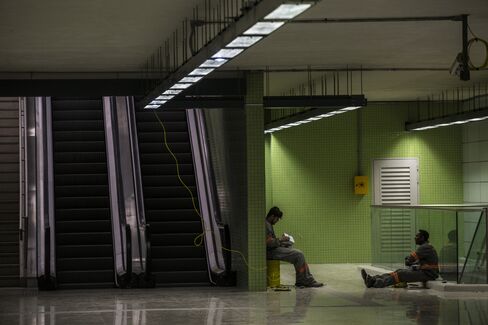
Workers sit beside escalators at the Nossa Senhora da Paz metro station in Rio de Janeiro.
Welcome to Brazil, a land of political, economic and fiscal crisis.
“When you look back at the bid documents from 2009, the Olympics were definitely designed and pitched as a way of showcasing Brazil as this thriving democracy and burgeoning economy,” said Jules Boykoff, the author of a book on Olympics history that’s critical about the legacy of major sporting events. “How big a difference seven years make.”
QuickTake: In Brazil, Hopes Give Way to Slump, Scandal, Turmoil
To be fair, most of the 39 billion reais ($11 billion) in arenas and infrastructure being built ahead of the Olympics will be ready in time and, besides a few eyesores and commuting delays, most tourists may not even notice all that should have been. But the unfinished work is an indication of a much bigger problem that will last long after the visitors jet out: Rio state is all but broke.
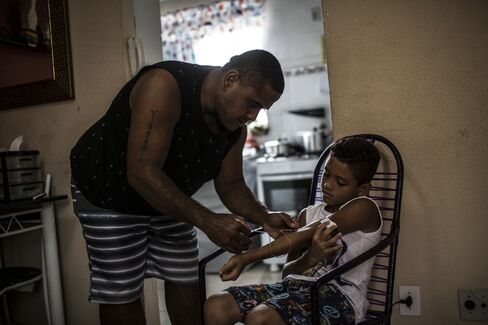
Rodrigo Batista da Silva administers state-issued medicine to his 9-year-old son.
No one knows that better than Joao Vitor da Silva and his father, Rodrigo da Silva. The scrawny nine-year-old in an Iron Man T-shirt is a hemophiliac, and Batista said they’ve been warned that public-health spending cuts may disrupt supplies of prophylaxis, the shots that prevent Joao from bleeding out whenever he’s injured or sick.
“If there’s money for the Olympics, there has to be money for health,” said Da Silva, a 34-year-old former forklift-operator who’s on medical leave.
Brazil’s hardly the first nation to host the Olympics games from a hotbed of chaos. (Russia, Mexico and South Korea are all part of the club.) Even so, the tumultuous backdrop when the games begin Aug. 5 is a far cry from the image of the up-and-coming powerhouse organizers had envisioned when hosting rights were awarded.
These days, Brazil is stuck in a crushing recession and Lula’s successor, Dilma Rousseff, was stripped of power while she faces an impeachment trial on allegations she illegally financed budget deficits. Rio state missed debt payments last month and is delaying public-worker salaries after oil prices collapsed, a primary source of revenue. And at least six companies contracted for Olympic projects and related infrastructure have been crippled by allegations they paid kickbacks to win lucrative public-works deals.
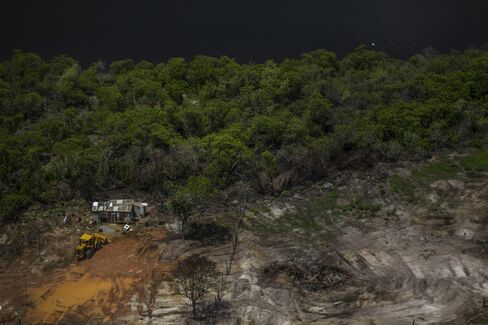
Mangrove trees at the border of Guanabara Bay.
Three of those companies -- builders Queiroz Galvao SA, OAS SA, and Andrade Gutierrez SA -- were responsible for a project to dredge four polluted lagoons and plant 500,000 mangrove trees in Barra da Tijuca, the key staging ground for the games. But work won’t be ready after public prosecutors requested delays and then the state faced cash shortages, according to the Environment Secretariat. A press official for the builders group confirmed that the pace of work has been “reduced” and declined to comment further.
“Rio is the showcase of Brazil -- of its incompetence and impunity,” said Mario Moscatelli, the biologist subcontracted by the construction firms to plant the mangroves. He says he’ll be able to finish less than 10 percent of the work.
Queiroz is also part of the group building the subway line from Ipanema to Barra, which still awaits a nearly 1 billion-real loan from the Rio-based national development bank before it can finish works.
Rio state projects a 20 billion-real deficit this year, of which 12 billion relate to the underwater pension system, and Thursday announced a new round of spending cuts. Almost 70 percent of public-school teachers and workers have been on strike since March as salaries are delayed, their union says. Rio city was forced to take control of two public hospitals, and a doctors’ group warns others may soon close for lack of funding.
The state also slashed its security budget by 32 percent this year and has delayed payments to police and their families. New equipment police expected for the games never materialized, and instead many officers are saddled with obsolete gear, said a high-ranking military police official, who asked not to be identified criticizing the budget cuts.
All major security investments for the Olympics have been carried out since 2012 or are in their final phase, and any personnel or equipment shortage during the games will be covered by federal security agencies, according to the press office of Rio’s security secretariat.
Leonardo Espindola, chief of staff to Rio’s governor, told the Supreme Court in April that the state is on the verge of “social collapse.” State Finance Secretary Julio Bueno agrees. At the outset of an hour-long interview last month, Bueno claimed to have “the worst job in Rio de Janeiro.”
“We’re unable to maintain essential services like police and health,” he said. “That’s what defines the health of a society.”
Monday, June 13, 2016
Hey, Siri, How Will Apple Keep Up With Google and Amazon?
- Apple’s virtual assistant set for prominent role at WWDC
- Updates to Apple Music, iOS, WatchOS and tvOS also expected
Asking Apple Inc.’s voice-activated assistant, Siri, what the company plans to unveil at its Worldwide Developers Conference in San Francisco next week elicits the response: “If I told you, they’d probably make me sit through product security again.”
Witty, perhaps, but Siri will have to supply more satisfying answers if it’s going to convince customers, developers and investors that Apple is keeping pace with Alphabet Inc.’s Google Now and Amazon.com Inc.’s Alexa in one of the hottest emerging areas of tech: virtual personal assistants.

The Echo
Alongside updates to Apple Music and the company’s mobile, watch and television operating systems, Apple will announce that for the first time it will let outside developers integrate Siri with their apps, according to a person familiar with the plans. Getting programmers on board is an essential step toward building tools that make Apple’s devices more indispensable -- such as apps that let you use voice commands on an iPhone or iPad to order a pizza or summon an Uber car, both of which Alexa can already do through the Echo in-home speaker.
“Siri needs to grow up and get smarter, and by being in other apps it will get smarter because it will know more of what I do,” said Carolina Milanesi, an analyst at Creative Strategies in San Jose, California. “It’s like quicksand -- if you move slightly, you sink deeper. It’s another little thing that gets you more entrenched into the ecosystem.”
Technology news website The Information reported in late May that Apple planned to open Siri to apps made by others.
App Ecosystem
Indeed, Apple is trying to pull people deeper into its network of apps and services -- from iTunes to Apple Music and iCloud storage -- to help make up for slowing iPhone sales. The developers conference, which focuses on software, has therefore become more significant for Apple after playing second fiddle to the company’s much-heralded hardware rollouts for years. Chief Executive Officer Tim Cook has repeatedly highlighted the importance of sales from services, which have become the fastest-growing part of Apple’s business.
As part of that drive, Apple earlier this week laid out changes to the App Store. Starting Monday -- the day the conference kicks off in San Francisco -- Apple will halve the portion of sales it takes from developers if customers subscribe to a product for more than a year, and it will let developers pay to get more prominent placement within U.S. App Store searches. A revamped music-streaming service will also feature in the presentation at WWDC, Bloomberg News reported in May.
A consumer shift toward music streaming poses a mounting threat to the $3.5 billion iTunes song-download business, and Apple’s year-old answer to Spotify Ltd. and Pandora Media Inc. has been troubled by tepid critical reception, infighting and executive departures. That’s prompted an overhaul of the $10-per-month Apple Music streaming service, which will be unveiled on Monday and include changes to the interface intended to make it more intuitive to use.
Siri’s Rivals
The race to develop the most useful virtual assistant will help decide whose products consumers use to engage with the digital world. Apple got a head start when it introduced Siri in 2011. Yet in the years since then it has lost ground to Google Now, which followed in July 2012, and Amazon’s Alexa, unveiled in November 2014.
That’s why the audience at Apple’s annual developer confab will pay particular attention to anything software chief Craig Federighi might say about improvements to Siri if he takes the stage at the Bill Graham Auditorium. A Siri developer kit -- the software tools that let programmers create applications -- would increase the number of products and services that iOS users can access through Siri, tying them more closely to Apple devices.

While virtual assistants will play an increasingly important role in the automated home, for now Siri’s abilities are aimed at ensuring customers keep buying iPhones and iPads. Significant improvements to Siri would make about one in five Americans more likely to buy an iPhone, according to a survey by advertising technology company Fluent LLC.
Home Hardware
Amazon released a software development kit for its virtual assistant a year ago and Google did the same in March, just two months before it announced an Echo competitor called Google Home. A Siri SDK could lay the groundwork for a similar piece of hardware from Apple, according to Royal Bank of Canada analyst Amit Daryanani.
Alexa is better than Siri at comprehending different accents and dialects, while Google Now has the edge in understanding the intent of a question and translating that into an action, such as checking your calendar or giving you driving directions, according to Rob May, chief executive of Talla Inc., a Cambridge, Massachusetts-based developer of virtual assistants for businesses. Apple’s advantage lies in its vast network of developers.
“Siri’s definitely behind the game,” May said. “But where Apple is in the lead is that they have the strongest developer ecosystem. As everything moves in the direction of virtual assistants then they have a great basis on which to build it.”
Subscribe to:
Posts (Atom)