Wednesday, June 24, 2015

US, allies ready to offer Iran nuclear equipment, document reveals


The United States and its allies are willing to offer Iran state-of-the-art nuclear equipment if Tehran agrees to pare down its atomic weapons program as part of a final nuclear agreement, a draft document has revealed.
The confidential paper, obtained by the Associated Press, has dozens of bracketed text where disagreements remain. Technical cooperation is the least controversial issue at the talks, and the number of brackets suggest the sides have a ways to go, not only on that topic but also more contentious disputes, with less than a week until the June 30 deadline for a deal.
However, the scope of the help now being offered in the draft may displease U.S. congressional critics who already argue that Washington has offered too many concessions at the negotiations.
The draft, titled "Civil Nuclear Cooperation," promises to supply Iran with light-water nuclear reactors instead of its nearly completed heavy-water facility at Arak, which would produce enough plutonium for several bombs a year if completed as planned.
Reducing the Arak reactor's plutonium output was one of the main aims of the U.S. and its negotiating partners, along with paring down Iran's ability to produce enriched uranium -- like plutonium, a potential pathway to nuclear arms.
Outlining plans to modify that heavy-water reactor, the draft, dated June 19, offers to "establish an international partnership" to rebuild it into a less proliferation-prone facility while leaving Iran in "the leadership role as the project owner and manager."
The eight-page draft also promises "arrangements for the assured supply and removal of nuclear fuel for each reactor provided," and offers help in the "construction and effective operation" of the reactors and related hardware. It also offers to cooperate with Iran in the fields of nuclear safety, nuclear medicine, research, nuclear waste removal and other peaceful applications.
As well, it firms up earlier tentative agreement on what to do with the underground site of Fordo, saying it will be used for isotope production instead of uranium enrichment.
Washington and its allies had long insisted that the facility be repurposed away from enrichment because Fordo is dug deep into a mountain and thought resistant to airstrikes -- an option neither the U.S. nor Israel has ruled out should talks fail.
But because isotope production uses the same technology as enrichment and can be quickly re-engineered to enriching uranium, the compromise has been criticized by congressional opponents of the deal.
A diplomat familiar with the negotiations said China was ready to help in re-engineering the heavy water reactor at Arak; France in reprocessing nuclear waste, and Britain in the field of nuclear safety and security.
He spoke on the eve of Wednesday's new round of nuclear talks in Vienna and demanded anonymity because he was not authorized to discuss the confidential talks.
Diplomats say the other appendices include ways of dealing with enrichment; limits on Iran's research and development of advanced uranium-enriching centrifuges and ways of making sure Tehran is keeping its commitment to the deal.
Iran has most publicly pushed back on how much leeway the U.N.'s International Atomic Energy Agency would have in monitoring Tehran's nuclear activities. Iran's supreme leader, Ayatollah Ali Khamenei, is rebuffing U.S. demands that the IAEA have access to military sites and nuclear scientists as they keep an eye on Iran's present activities and try to follow up suspicions that the country worked in the past on a nuclear weapon.
But a senior U.S. official who demanded anonymity in exchange for commenting on the talks said Tuesday that the sides are still apart not only on how transparent Iran must be but all other ancillary issues as well. Separately, White House spokesman Josh Earnest suggested the talks could go past June 30.
If a deal "requires us to take a couple of extra days ... then we'll do that," he said.
A delay up to July 9 is not a deal-breaker. If Congress receives a deal by then, it has 30 days to review it before President Barack Obama could suspend congressional sanctions.
But postponement beyond that would double the congressional review period to 60 days, giving both Iranian and U.S. opponents more time to work on undermining an agreement.
Earnest indicated that negotiations may continue even if the sides declare they have reached a final deal, in comments that may further embolden congressional critics who say the talks already have gone on too long.
He said that even past that point, ongoing "differences of opinion ... may require additional negotiations."

Monday, June 22, 2015

With Greece on brink of default, hopes for a breakthrough put on hold


Greek Prime Minister Alexis Tsipras at a meeting in Brussels ahead of a Eurozone emergency summit on Greece on June 22, 2015. The European Union welcomed new proposals from Greek Prime Minister Alexis Tsipras as a "good basis for progress" to avoid bankruptcy. REUTERS/Yves Herman (Yves Herman/Reuters)

 Negotiators made progress toward an 11th-hour agreement to prevent Greece from defaulting on its debt and crashing out of the euro zone, but not enough to seal a deal on Monday at a crisis summit, officials said following talks in Brussels.
A new Greek proposal made late Sunday night was "a basis to re-start the talks and in the next couple of days to get a result," said Eurogroup President Jeroen Dijsselbloem following a meeting of European finance ministers.
But there had not been enough time to review the proposals before European leaders hold an emergency summit Monday evening that had been seen as the last chance for a breakthrough after months of deadlocked and acrimonious negotiations.
Earlier, officials on both sides had expressed optimism that a deal was within sight.
European Union economic commissioner Pierre Moscovici told Europe 1 radio that “we are moving in the right direction. We have solid ground for a deal.”
Greek Prime Minister Alexis Tsipras, upon arrival in Brussels, said it is now the “time for a substantial and viable solution that will allow Greece to come back to growth within the euro zone.”
But European finance ministers poured cold water on the idea that the vast gulf between Greece and its creditors could be bridged in a single day, suggesting it won’t be easy to reach a deal to keep Greece from defaulting on $1.7 million worth of debt owed to the International Monetary Fund at the end of the month.
European officials said Greece had sent its new proposals too late Sunday evening to reach any tangible deal Monday, and that Greece had sent different versions that contributed to confusion over its stance.
Now the talks will continue for at least several more days, meaning that Greece will remain in economic limbo.
Nonetheless, markets across Europe were clearly anticipating a successful outcome to the negotiations – if not on Monday, then sometime before the end-of-month deadline. Stock indices rose across the continent and Greek bond yields falling sharply, indications that investors see less risk than they had on Friday.
Greece’s leftist government has been locked for months in a game of chicken with its European creditors. Each side has suggested grievous harm for the other if a deal can’t be reached.
For Greece, failure of negotiations could mean an unceremonious exit from the euro zone, and potential economic cataclysm for a country already ravaged by its sky-high debt and the austerity policies prescribed as the cure.
For Europe, a Greek exit could set a dangerous precedent with consequences for other struggling economies along the continent’s southern periphery, including Italy, Portugal and Spain.
It could also have dangerous security implications at a time when Greece is struggling with an extraordinary influx of migrants from South Asia, Africa and the Middle East. In addition, Greece, a NATO member, has made no secret of its flirtation with Russian President Vladimir Putin as a possible alternative lender if Europe’s patience runs out.
Since his election in January, Tsipras has demanded that Europe write off some of Greece’s debt and ease up on the austerity policies implemented as a condition of the $264 billion worth of bailouts the country has received since 2010 from the IMF, the European Commission and the European Central Bank.
Europe, in turn, is asking Greece for pension cuts, labor market reforms and tax increases in order to put the country’s balance sheets on a better footing.
Greece’s leaders say such measures have already shrunk the economy by a quarter and sent unemployment above 25 percent. But they may have to accept them in order to get the funds they need to avoid a default.
No details of Greece’s latest proposals were made public on Monday. They could, however, cross previously declared “red lines” such as raising the retirement age and the value-added tax.
Greece’s economic crisis has been compounded in recent weeks by a steady exodus of cash from Greek banks, with billions of euros withdrawn last week alone. Greek banks have required several rounds of emergency loans from the European Central Bank just to stay in business, the latest coming on Monday.
There was widespread speculation Monday that any deal will be a stopgap move at best — perhaps just a six-month extension that would allow Greece to keep paying its bills this year, but set up yet another round of potentially contentious talks toward the end of 2015.
Even if Greece and Europe can come to agreement Monday, it could be hard for Greek leaders to sell the deal at home. Greece’s ruling Syriza party was elected on a pledge to end austerity, and any new austerity measures could spawn a backlash within the party’s left-wing membership and with its right-wing coalition partner.
Brian Murphy in Washington contributed to this report.

Friday, June 19, 2015

Paris Air Show Buzzes Over Boeing Jet That Doesn’t Exist Yet

David Joyce
General Electric Co.’s GE Aviation CEO David Joyce speaks during the Paris Air Show in Paris. Photographer: Jason Alden/Bloomberg
As aviation leaders mingle in Paris for the industry’s largest expo, much of the talk centers on a Boeing Co. plane nicknamed “Mom” that doesn’t even exist yet.
The tag is an acronym used internally at Boeing for “middle of market,” a jet that would be sized to fit between current single- and twin-aisle offerings and succeed the discontinued 757.
No matter that it wouldn’t be in service until the 2020s. Just the promise of the first all-new Boeing since the 787 Dreamliner is enough to generate a Paris Air Show buzz, especially with product introductions noticeably absent this year. Lessors, engine makers, airlines and Airbus Group SE are all chiming in on the potential benefits and pitfalls.
“I would argue that certainly there’s a market there,” said David Joyce, chief executive officer of General Electric Co.’s GE Aviation, which is “working on some technologies and some capabilities” for a 757-class plane.
As now envisioned, the jet would seat about 220 people and fly 4,500 nautical miles (8,300 kilometers), according to Mike Sinnett, Boeing’s vice president for product development. That load and range -- farther than a flight between Houston and London -- would be upgrades of roughly 20 percent over a narrow-body 757.
“You don’t have to have a single-aisle plane to have single-aisle economics,” Sinnett said.
Old Favorite
The old plane went out of production a decade ago but remains cherished by some airlines for use on U.S. transcontinental trips and long-haul routes too thinly traveled to justify a bigger aircraft. A new jet would benefit from advances in aerodynamics, structures and engines unavailable on the earlier model, Sinnett said.
Potential customers like Air Lease Corp. CEO Steven Udvar-Hazy are helping Boeing decide on details such as having one or two aisles, Sinnett said Wednesday in an interview at the air show. A pair of aisles would eliminate middle seats in a six-abreast cabin, creating speedier boarding and unloading.
“Boeing is well aware of our requirements,” said Udvar-Hazy, the self-described godfather of jetliner leasing.
CCC Portfolio
All-new jets don’t come along that often. Before the 787 debuted in 2011, Boeing’s last built-from-scratch model was the 777 in 1995. They’re also not cheap: Airbus CEO Fabrice Bregier estimated Monday that Boeing would have to invest about $10 billion to get a 757 successor to market.
Getting Ready
“We’re continuing to prepare ourselves for that day, should it occur,” Scott Fancher, the Boeing’s airplane development chief, said Wednesday.
The sales potential is strong, but Chicago-based Boeing won’t share its market estimates, according to Randy Tinseth, vice president of marketing and sales. Airbus has pegged potential demand in the middle-of-the-market category at about 1,000 jets -- and attacked Boeing on the flank left open when it dropped the 757.
Airbus added wing fins dubbed sharklets on the largest single-aisle model, the A321, to extend its range. It created the A321neo Long-Range, featuring an extra fuel tank, and updated its smallest wide-body, the A330, to boost efficiency. It’s not above crowing about the changes.
“Competition is so strong from us between the A330neo and the A321 that Boeing knows it doesn’t have anything to go up against that,” said Kiran Rao, director of strategy at Airbus. “They’re having to think about doing something new.”
Mom Aircraft
Boeing has been publicly tiptoeing toward the idea of a 757 successor for years while cautioning that any new aircraft would borrow from existing models and not, as CEO Jim McNerney said last year, be a bet on “moon-shot” breakthroughs.
The challenge: How many airlines would pay a premium for new engines and operating efficiencies over the upgraded A321s? Even when the 757 was being built, Boeing found many buyers made do with either its largest 737 jet or a small wide-body, squeezing the room to sell a Mom aircraft.
“You have to make sure if you do build an airplane like this that it’s not over-engineered and therefore overpriced,” said CEO Aengus Kelly of lessor AerCap Holdings NV. “It’s not a long-range airplane. It’s not going to be a traditional wide-body aircraft, so you can’t charge those prices.”
Even if Boeing were ready to commit now, development running into the next decade would ensure more air-show gossip and speculation.
Just crafting an engine for the new Boeing probably would take five years, said Safran SA CEO Philippe Petitcolin, whose company is a partner with GE in engine-maker CFM International.
“I don’t think we are that close to a decision, not in the next 18 months to two years,” Petitcolin said. “We are in the early, early stages.”

Thursday, June 18, 2015

Last Chance to Reserve your Seat !!!! June 23, 2015 Seminar


CAMACOL - The U.S. Secret Service and e-Chip payment industry experts,
cordially invite you to join us for a 
Free Seminar on
What your business needs to know 
on the current fraud trends impacting merchants 
and the payment changes that will provide advanced 
Security for merchants and cardholders

Seminar will be:
On Tuesday, June 23, 2015, from 2:00 - 4:00 pm
At CAMACOL Tower Building: 1401 W. Flagler Street,
Miami, FL 33135

(Free Parking will be available across the street at the St. John Bosco Church

On October 1, 2015 the way to pay, get paid and secure our payments will change:
Merchants not ready to accept cards with chip will lose their chrageback rights

A new, secure way to pay reduces fraud at the point of sale, enhances customer experience, reduces chargebacks, and increases sales has finally arrived. 

A payment paradigm shift is happening, don't be left behind !

The secure, dynamic, and versatile Chip technology on debit and credit cards will replace the antiquated and vulnerable magnetic stripe technology used in cards today.

To reserve your seat:
Please, RSVP to: Dianelys Garcia -dgarcia@camacol.org- 305-642-3870 x 205 

First Direct Shipment from Poland to Miami ...celebration June 19, 2015

Innovation Technology Hub Of The Americas
On behalf of The Innovation Technology Hub of the America’s (ITHOTA), I am delighted to announce eGoo’s arrival to the markets of the Americas.  eGoo is the first all natural energy drink to be introduced to the market. This accomplishment represents another milestone in the growing business ecosystem surrounding our initiative. The experience and dedication of the organizations that make up ITHOTA offer an expanding and unique advantage in accessing new markets.


PortMiami Logo - Home

PortMiami: 1015 N. America Way, 2nd Floor - Miami, Florida 33132 - Main No. 305-347-4800
In recognition of the first direct shipment of EGOO
from Poland to PortMiami.

June 19, 2015

We commemorate this shipment as the first of many
as we forge a new trade route and build new relationships between Poland and PortMiami.

~ Juan Kuryla 


Wednesday, June 17, 2015

The World Is Facing Its Longest Oil Glut in at Least Three Decades (BusinessWeek)

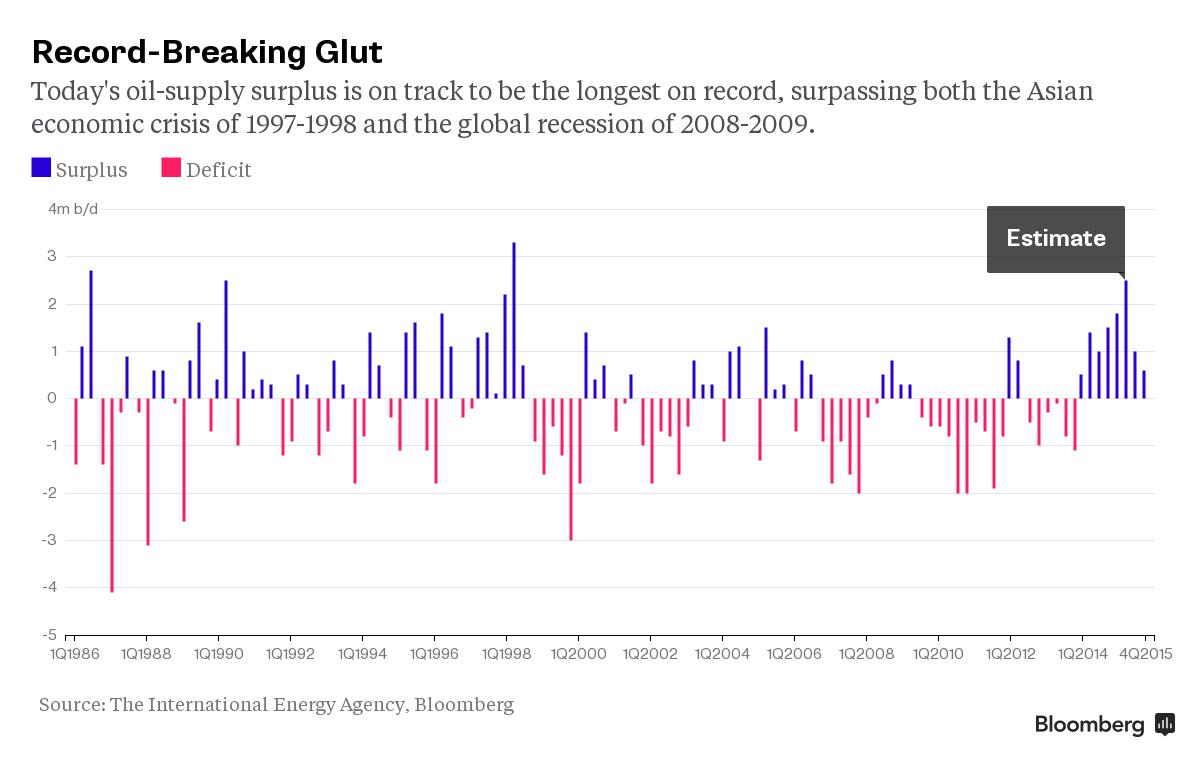
The world is on the brink of the longest-lasting oil glut in at least three decades and OPEC’s quest for market share makes it almost unavoidable.
Record-Breaking Glut
Oil supply has exceeded demand globally for the past five quarters, already the most enduring glut since the 1997 Asian economic crisis, International Energy Agency data show. If the Organization of Petroleum Exporting Countries were to keep pumping at current rates it would become the longest surplus since at least 1985 by the third quarter, the data show.
There are few signs the 12-nation group will cut back. Saudi Arabia, OPEC’s biggest member, will probably increase production to intensify pressure on U.S. shale drillers, Goldman Sachs Group Inc. predicts. OPEC’s supplies may be swollen further this year if Iran reaches a deal with world powers to ease sanctions on its exports, Commerzbank AG says.
“It seems to be taking longer for the oil surplus to clear, and, even without the return of Iran, IEA data indicates it could last for the rest of the year,” said Eugen Weinberg, head of commodities research at Commerzbank in Frankfurt. “Any expectations the oversupply will be gone by 2016 don’t look justified at this stage.”
Brent crude for August settlement dropped 18 cents to $63.77 a barrel on the London-based ICE Futures Europe exchange at 10:17 a.m. London time. The benchmark has risen about 40 percent since reaching a six-year low of $45.19 on Jan. 13.
OPEC pumped 31.3 million barrels a day in May and will probably continue to pump around that level “in coming months,” the IEA said in a report on June 11. The agency doesn’t forecast OPEC production.
Oil supply has exceeded demand globally for the past five quarters, already the most enduring glut since the 1997 Asian economic crisis, International Energy Agency data show. If the Organization of Petroleum Exporting Countries were to keep pumping at current rates it would become the longest surplus since at least 1985 by the third quarter, the data show.
There are few signs the 12-nation group will cut back. Saudi Arabia, OPEC’s biggest member, will probably increase production to intensify pressure on U.S. shale drillers, Goldman Sachs Group Inc. predicts. OPEC’s supplies may be swollen further this year if Iran reaches a deal with world powers to ease sanctions on its exports, Commerzbank AG says.
“It seems to be taking longer for the oil surplus to clear, and, even without the return of Iran, IEA data indicates it could last for the rest of the year,” said Eugen Weinberg, head of commodities research at Commerzbank in Frankfurt. “Any expectations the oversupply will be gone by 2016 don’t look justified at this stage.”
Brent crude for August settlement dropped 18 cents to $63.77 a barrel on the London-based ICE Futures Europe exchange at 10:17 a.m. London time. The benchmark has risen about 40 percent since reaching a six-year low of $45.19 on Jan. 13.
OPEC pumped 31.3 million barrels a day in May and will probably continue to pump around that level “in coming months,” the IEA said in a report on June 11. The agency doesn’t forecast OPEC production.
Global Oversupply
Producing at that level would imply a global oversupply of 1 million barrels a day in the third quarter and 600,000 barrels in the following three months, according to IEA projections for global demand and non-OPEC supply compiled by Bloomberg. That would be the eighth consecutive quarterly surplus, exceeding the current record of six quarters from 1997 to 1998.
The glut could swell further if Iran and world powers reach an accord on the Islamic Republic’s nuclear program by their June 30 deadline, Commerzbank predicts. The country could boost exports by 1 million barrels a day within seven months of sanctions being removed, Oil Minister Bijan Namdar Zanganeh said in Vienna on June 3.

Tuesday, June 16, 2015

This Map Shows How Fast Each State Grew Last Year

From Texas and Wyoming to Oregon, growth is heating up west of the Mississippi

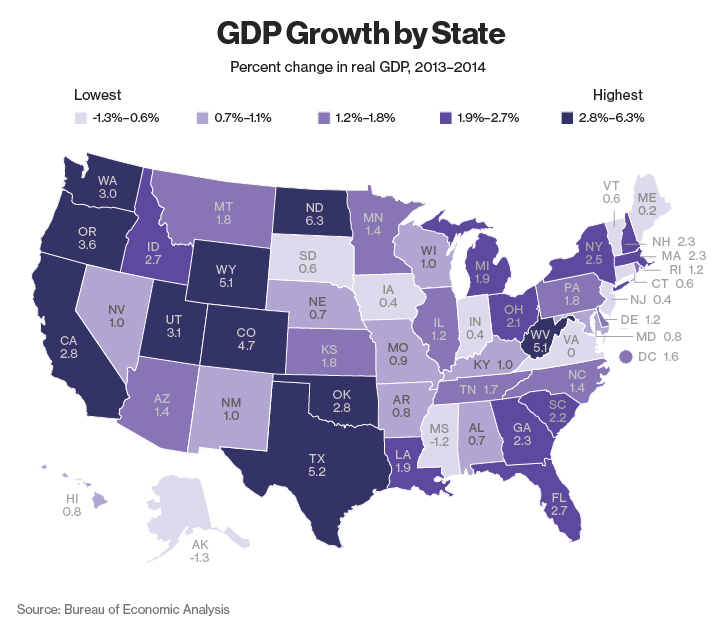
The nexus of U.S. growth shifted farther west in 2014,  a report released by the Bureau of Economic Analysis Wednesday showed.
Gross domestic product increased by 4.3 percent in the Southwest last year as mining helped Texas boost its output by 5.2 percent, giving it the second-fastest growth rate of any state. The Rocky Mountain region saw a 3.9 percent expansion as the Far West, which includes California, Oregon, Washington and Nevada, grew 2.7 percent.
In addition to mining, professional, scientific and technical services helped Western states pull ahead from the rest of the nation last year. The latter made the biggest contribution to U.S. output growth by state in 2014
.
North Dakota was the fastest-expanding state last year, growing 6.3 percent, following a 0.9 percent advance in 2013 that was revised down sharply from a previously reported 9.7 percent rate.

Still, the states boosted by mining in 2014 might benefit less this year. Oil prices so far this year have averaged about half of what they averaged during the same period a year earlier. Monthly employment data shows that cheap oil has already taken a toll on the industry. Jobs in the oil and gas industry dropped to 193,800 as of May 2015, down from a high of 201,500 last October.  

States bringing up the rear included Mississippi — where the economy contracted 1.2 percent last year after dropping 1.1 percent in 2013 — and Alaska, which shrank 1.3 percent following a 4 percent contraction the prior year.

Overall, the U.S. economy expanded 2.2 percent in 2014 based on the state accounts, following 1.9 percent growth the prior year. 

The BEA in September will start releasing state GDP data for each quarter, beginning with figures for the first three months of 2015 and going back to 2005.