|

Wednesday, December 2, 2015
SFTA Chair Joe Monaco Selected for 2015 Techweek Miami 100


Tuesday, December 1, 2015
Calendar of Events -December 2015-Miami-Dade College CLACI

(These
activities will be in Spanish)
Presentation
of the book “From Orwell to Vargas Llosa. Notes on Literature and Freedom” by
Bolivian author Emilio Martinez Cardona.
This
event is jointly convened by CLACI, the Interamerican Institute for Democracy
(IID), and Diario Las Américas. Other speakers include writer Carlos
Alberto Montaner and Ambassador Armando Valladares.
Monday,
December 7, from 6 pm to 9 pm. Wolfson Campus. Building 6 (Room 6100) at
300 NE 2nd Ave, Miami. Free parking is available at the garage on 5th
Street (NE) between 1st and 2nd Avenues (entrance located
on the left side, across the fire station)
Colloquium on
the political repression of women in Latin America.
This
event is jointly convened by CLACI and “Each 15 Seconds”, Arts Connection, 305
PR, and Fefi TeVe.
Cada
15 segundos, an all women group, is integrated by
authors and journalists from Argentina, Colombia, Cuba and Venezuela, among
other nationalities, who will share with the audience their experiences
and perspectives on political repression against women in the region. Some of
their latest books will be available to be sold and autographed. Speakers include Pilar Vélez ("El Expreso
del Sol"), Patricia Poleo ("Fugitiva en Rosa"),Vilma
Petrash (Temas de Mujer TV), Nina Fuentes-(AKA Nina Dotti - Canal de
Protesta), Christina Balinotti (“La Mujer Holística”), Jenny
Villasana (El Carrusel de los Sueños - Radio), Fefi Toll (Directora
Cada15Segundos.org). Author María Elena Lavaud
(“Tatuaje de Lágrimas”) will act as moderator.
Tuesday,
December 8. From 6 pm to 9 pm. Wolfson Campus, Building 6 (Room 6100) at
300 NE 2nd Ave, Miami Free parking is available at the garage on 5
Street (NE) between 1st and 2nd Avenues (entrance located
on the left side, across the fire station)
·
International Day of Human
Rights. A Latin-American Overview.
This
CLACI event is cosponsored by the Sociedad Interamericana de Prensa
(SIP), the Instituto Interamericano para la Democracia (IID) and the Comite
Cubano Pro Derechos Humanos. Presentations include Cuban
writer Carlos Alberto Montaner, Venezuelan internationally known
political activist and MDC guest professor Carlos Vecchio, and
the Executive Director of the Sociedad Interamericana de Prensa (SIP),
Ricardo Trotti (Argentina). Ofelia Acevedo, widow of Cuban political
dissident Oswaldo Paya, will speak on behalf of the Cuban Committee for Human
Rights to recognize the lifelong contributions made to this cause by Ricardo
Bofill who will also be present for the event..
Wednesday,
December 9 from 3 pm to 5 pm. InterAmerican Campus (Room 3103).
627 SW 27th Ave. Miami, FL 33135 Free parking is available at the open
lot of the campus located behind the main building)
Colloquium
with Myriam Millan, winner of the second international literary contest of
independent authors.
This
event is jointly convened by the Center for Latin American and Caribbean
Initiatives (CLACI) of Miami Dade College and the Centro Cultural Español of
Miami (CCEM). Opening remarks by Fracisco Tardio, Director of the Centro
Cultural Español de Miami. Rex Czuba, global manager of
Kindle Direct Publishing in Spanish will explain the details of this contest
and introduce the author. .
Tuesday,
December 15 from 6 pm to 9 pm. Wolfson Campus,
Building 6 (Room 6100) at 300 NE 2nd Ave, Miami. Free parking is
available at the MDC garage on 5th Street (NE) between 1st
and 2nd Avenues (entrance located on the left side, across the fire
station)
Monday, November 30, 2015
Oil recovery will take 5 years: IEA

Energy watchdog warns of a return to 1970s style over-dependence on Middle East–and this time it’s Asia’s problem.
Prices for crude oil, the world economy’s most essential commodity, will need until 2020 to recover from the price war unleashed last year by Saudi Arabia, the International Energy Agency said Tuesday.
But while that’s good for energy consumers across the world, it makes them more dependent on a small handful of politically volatile, mainly Middle Eastern, producer countries than at any time since the 1970s, the Paris-based watchdog warned in its closely-watched annual outlook for the world energy market.
Under its base case scenario, the IEA said it expects crude prices to recover to around $80 a barrel by 2020, as the market gradually rebalances by taking high-cost supply out of the market and encouraging higher demand growth. Thereafter, it expects only tepid demand growth for another 20 years, as alternative sources, especially renewables, expand their share in the energy mix.
The promise of $80 oil is a comforting message to western oil companies that have been slashing jobs and investment this year in anticipation of much lower prices. BP Plc BP -0.83% recently outlined plans where it could continue to grow and pay dividends even at an oil price of $60/bbl, while Chevron Corp. CVX 0.27% and ConocoPhillips COP -0.81% last month also announced aggressive cost savings as spot prices headed back below $45/bbl.
U.S. shale producers too, will be happy if the IEA’s base case plays out. If prices recover as it expects, then U.S. tight oil output should rise by 1.5 million barrels a day by 2020 to over 5 million b/d, according to the IEA.
However, it warned that “a substantial decline in output” is likely in the near term if prices remain below $60. And it warned that prices could stay stuck in the $50-$60/bbl range if Middle Eastern producers, notably Iraq and Iran, can create a political climate stable enough to realise the potential of their low-cost reserves–always a big ‘if’, but one that has “a clear pathway” now that sanctions on Iran are set to be lifted.
Oil prices have fallen 10% in the last week as hopes for a quick end to the Saudi-led price war have faded. The benchmark U.S. crude oil future currently trades at just over $44/bbl. Media reports suggest that there is little chance of the Organisation of Petroleum Exporting Countries agreeing to cut its output this year, despite the increasing strain on their budgets. Saudi Arabia is going so far as to borrow on the international capital markets–an option not available to other OPEC members such as Iran and Venezuela.
But as low-cost Middle Eastern producers regain market share, the IEA warned, the risk of over-dependence on the region rises again. And with oil demand falling in developed economies as renewable energy sources gain ground (the IEA predicts combined U.S., Japanese and E.U. oil demand will fall by 10 million b/d by 2040), it’s the rising economies of Asia that will be most acutely exposed.
“A concentration of global supply would be accompanied by elevated concerns about energy security, with Asian consumers… particularly vulnerable,” the IEA said.
By 2040, it expects China’s oil imports to be five times those of the U.S., while India’s will “easily exceed” the European Union’s.
Thursday, November 19, 2015
10 major US cities that are embracing the cloud
1.- Boston, Massachusetts
Despite being known as a sector slow to adopt new tech,
many city governments are embracing the cloud. Here are 10 of the most
cloud-friendly cities.
In 2014, the city of Boston moved almost 80,000 employees the cloud.
The city relies on Google Apps to support everyone from police officers to
public school teachers.

2. New York,
New York
New
York City was early on the cloud trend, making the move to use a plethora of
Microsoft cloud tools in 2010.

3. San
Francisco, California
A
city known for its willingness to embrace new technology, San Francisco began
moving many of its employees to the Office 365 platform in early 2014.

4.
Philadelphia, Pennsylvania
Philadelphia
has a cloud-based 311 phone service for municipal services for residents, and
its chief innovation officer eventually wants to move 50% of its IT assets to the cloud.

5. Miami,
Florida
For
its private cloud, Miami was awarded the Public Technology Institute’s Annual Solutions Award in 2013. Miami has also been developing cloud appsto help with public
inspections.

6. Asheville,
North Carolina
The
city of Asheville won an award in 2015 for its cloud-based approach to data recovery.

7. Los Angeles,
California
Another
city using Microsoft Office 365, Los Angeles moved 100,000 employees to the platform starting in 2014.

8. Louisville,
Kentucky
In
addition to being named one of the top digital cities in the US,
Louisville was also one of the winners of Amazon's City on a Cloud challenge for its work building open data sites
on AWS.

9. Phoenix,
Arizona
Phoenix
not only uses a host of cloud tools, but it has also takes a comprehensive
approach to the cloud as evidenced by its cloud computing audit report

10. San Jose,
California
San
Jose began the move to Microsoft's cloud suite in 2013 to save money and
increase efficiency.

Wednesday, November 18, 2015
Paris, ISIS, Social Media & Encryption
How were the terrorists in Paris communicating?
Shelly Palmer talks about it with Juliet Huddy and Teresa Priolo on Fox 5. Original Airdate: November 17, 2015
Watch this analysis at:
Monday, November 16, 2015
Comcast launches a $15 video streaming service ...
...that actually makes sense for cord cutters !

The company we all love to hate announced the launch of its new “Stream” service in an effort to win back cord cutters. Unlike the completely misguided attempt by Time Warner to win customers back by showing fewer commercials and pulling its programming from Netflix, Comcast’s idea actually makes sense for cord cutters.
The Stream plan is a $15 per month service (including taxes and fees) and it includes local networks, HBO and on-demand movies and television shows.
Two catches.
The first is you have to live in the Boston area — which includes all of eastern Massachusetts, Maine and New Hampshire — but the company plans to launch in Chicago and Seattle shortly after and nationwide by early 2016.
Secondly, you must be an Xfinity (Comcast Internet) customer.
On the plus side, it’s at least a working model that will force other ISPs to take notice. If it’s successful, you can bet that your ISP will begin offering a similar take on Comcast’s Stream.
This doesn’t solve every problem with cable, but it’s a step in the right direction.
Thursday, November 12, 2015
The Case for Buying a Home You Can't Afford (BusinessWeek)
Trulia crunched income data to identify cities where mortgages will soon look more affordable.

Here’s a happy reminder if you're someone who finds escape by perusing real estate listings for unobtainable homes: A mortgage that strains your budget now will be a lighter burden a few years, and a couple of job promotions, down the line.
Young professionals willing to stretch their budgets now should consider Boston, Seattle, and Washington, D.C., among other cities, according to a new report from Trulia. In New Haven, Conn., the typical millennial (defined by Trulia as an adult between ages 25 and 34) can expect to spend 37 percent of her income on housing in the first year of her mortgage. Three years later, though, the same homebuyer’s monthly payments will fall below 31 percent of her income, according to Trulia’s estimates. By the last year of her 30-year mortgage, she’ll be spending 11 percent of her income on housing.
"There's a sweet spot of metros where a mortgage looks obtainable but unaffordable, but where it doesn't take long to become affordable," said Ralph McLaughlin, a housing economist at Trulia.
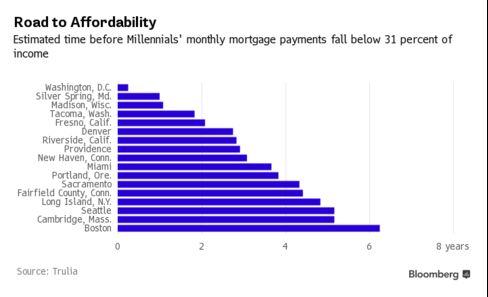
Trulia built its model on the rough assumption that in three decades, today’s 25-year-olds will earn the same as today’s 55-year-olds. (It also baked in some inflation.) That seems like a reasonable basis for comparing local housing markets, but an overly broad one for making financial decisions.
Here are some other caveats: It wasn’t very long ago that U.S. homebuyers helped wreck the world economy by stretching their budgets to buy homes they couldn’t afford. Don’t do that. And even if you want to, it will be harder to find an enabling mortgage lender this time around. The average debt-to-income ratio that a borrower needs to close a loan has hovered around 25 percent in recent years, according to mortgage software company Ellie Mae, indicating that many buyers would struggle to convince a lender to let them stretch.
The other thing that stands out in the Trulia report is the low likelihood that young workers will ever be able to afford homes in California. In San Francisco, the typical millennial will still be spending 48 percent of her income on housing in the last year of her mortgage. In San Jose, the figure is 38 percent. In other words, the median home will still be unaffordable to the median millennial when that group is approaching retirement. It’s a grim picture up and down the coast.
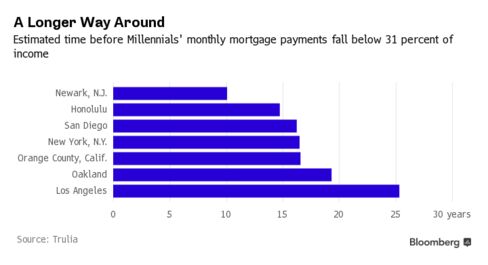
California, to judge from the above, looks destined to become the land of the elderly.
Subscribe to:
Posts (Atom)